The Human Element
What is an AI HR Generalist?
What is an AI HR generalist? Learn how AI HR generalists support employees and managers, scale HR service delivery, and work alongside human HR teams.

An AI HR generalist is an AI teammate designed to support the full scope of day-to-day HR work — answering employee questions, guiding managers through people situations, routing requests, and ensuring policy compliance — while escalating sensitive, complex, or high-risk matters to human HR professionals. Powered by an agentic AI platform like Wisq, it mirrors the breadth of a human HR generalist, not a single HR speciality.
The idea of an AI HR generalist reflects a simple reality: Employees don't experience HR as a collection of separate functions. They experience HR as a single service — one place where they go for answers about policies, leave, benefits, and performance. HR generalists — whether human or agentic — exist to meet that need, acting as a connector between employees, managers, policies, and HR specialists.
This connective role has only become more crucial as HR teams have faced growing job complexity in recent years. From hybrid and remote work to multi-state compliance and rising employee expectations for fast and consistent support, HR leaders face new challenges — and mounting pressure to spend less time on repetitive service work and more time on judgment-driven, high-impact initiatives that drive business outcomes. SHRM's 2025 State of the Workplace report showed 62% of HR professionals say their departments operate beyond their capacity, signaling a need for new ways for HR professionals to deliver support at scale.
To better understand what makes an AI HR generalist distinct — and why the concept is so important in today's HR landscape — it helps to start with the human role it's modeled after, and how that role differs from HR specialists.
What Is the Difference Between an HR Generalist and an HR Specialist?
Most HR organizations are structured around two complementary types of roles: HR generalists and HR specialists. While both are essential, they have important differences when it comes to scope, depth, and how they support employees and managers.
HR generalists are designed for breadth. They handle a wide range of employee needs, act as a "front door" to HR, and help navigate issues that often span multiple HR domains.
HR specialists are designed for depth. They tend to focus on specific functional areas — benefits, compensation, employee relations, learning and development, etc.
HR organizations need both because issues rarely fit neatly into a single HR category; for example, a question about leave is likely to overlap with benefits, or a performance concern may raise compensation or compliance considerations. HR generalists provide continuity across all the HR touchpoints that comprise the entire employee lifecycle; HR specialists step in when deep expertise is required.
HR Generalists
- Scope: Broad and cross-functional
- Role: First point of contact (HR's "front door"); provides triage and coordination
- Type of work: High volume, varied requests, escalates to specialists as needed
HR Specialists
- Scope: Narrow and domain-specific
- Role: Deep expertise and program ownership
- Type of work: Complex, specialized cases, handles escalation within their speciality
What Is an HR Generalist?
An HR generalist is a human resource professional responsible for supporting employees and managers across a wide range of HR topics. Rather than specializing in any one function, HR generalists serve as a central point of contact, helping people understand policies, navigate processes, and determine next steps whenever issues arise at work.
HR generalists play important roles in organizations of all sizes, ensuring consistency, responsiveness, and continuity across the employee lifecycle. Also important to note is that HR generalists can be very experienced HR pros — the role is defined by scope, not seniority.
What Are the Key Responsibilities of an HR Generalist?
Common responsibilities for HR generalists include:
- Acting as a first point of contact for employee HR questions and requests
- Interpreting and explaining company policies and procedures
- Managing HR requests, from intake to triage, routing, and follow-up
- Coordinating employee onboarding and offboarding
- Helping employees navigate their benefits and leave processes
- Assisting with performance management cycles and documentation
- Guiding managers through common people issues, like feedback or attendance concerns
- Maintaining HR records and/or HRIS
- Working with HR specialists, legal, payroll, and/or IT when issues require escalation
- Supporting compliance by documenting and adhering to policies
What Are the Required Skills and Qualifications of an HR Generalist?
HR generalists typically need:
- A working understanding of employment law and HR compliance
- Strong written and verbal communication skills
- Judgment and discretion when handling sensitive employee information
- Case management and documentation discipline
- Process-oriented thinking and attention to detail
- Familiarity with common HR systems and tools (HRIS, knowledge bases, ticketing systems, etc.)
- Basic coaching skills
- Ability to multitask and handle ambiguity and shifting priorities
What Is an HR Specialist?
An HR specialist is an HR professional who focuses deeply on a specific functional area within human resources. Rather than covering the full range of HR activities, specialists develop expertise into one domain and become responsible for designing, executing, and governing programs in that area.
Common HR specialist roles include talent acquisition, benefits, learning and development, HR operations, and compliance. In larger organizations, specialists may operate out of centers of excellence that support the broader HR team.
According to the Bureau of Labor Statistics, HR specialist roles are projected to grow 6% from 2024 to 2034, with an average of 81,800 openings per year. That's faster growth than the average for all occupations, which reflects the demand for specialized HR expertise now and in the near future.
What Are the Key Responsibilities of an HR Specialist?
While exact responsibilities vary by speciality, HR specialists commonly:
- Design and execute programs within their domain
- Provide expert guidance to HR generalists and managers on complex or high-risk issues
- Interpret regulations and policies specific to their functional area
- Manage relationships with external vendors and service providers
- Handle escalations, exceptions, and edge cases
- Develop policies, training materials, and internal documentation
- Monitor compliance requirements and mitigate organizational risk
- Analyze data to assess program effectiveness and implement improvements
What Are the Required Skills and Qualifications of an HR Specialist?
HR specialists typically need:
- Deep subject matter expertise in their HR discipline
- Strong understanding of regulatory, compliance, and risk management topics
- Advanced documentation and organizational abilities
- Program and project management experience
- Ability to collaborate closely with legal, finance, and executive stakeholders
- Clear communication skills and ability to explain complex topics
- Relevant training and certifications, depending on speciality
Do Organizations Still Need HR Generalists?
Even as HR teams become more specialized (and automation and AI become more common), there is growing demand for HR generalists. According to the Dexian Talent Trend Report, there were nearly 60,000 unique U.S. job postings for HR generalist roles in just Q2 of 2025, with demand increasing 9% quarter over quarter.
The reason is simple: Organizations still need someone to provide consistent policy interpretation, act as a triage layer, offer continuity across employee lifecycle issues, and respond quickly when HR issues arise.
It makes sense when you think about how HR issues work in the real world — they don't arise as clearly defined "benefits," "performance," or "compliance" cases. They tend to begin more ambiguously — as questions about eligibility, expectations, timing, or processes — that need interpretation before they can be routed correctly. HR generalists provide the interpretation, helping organizations avoid bottlenecks and making sure questions and issues go to the right place and get escalated when needed.
Are HR Generalists Becoming Obsolete?
As emerging technology impacts more of HR's day-to-day work (and more on that in the next section), it's easy to question whether certain HR roles are headed toward obsolescence. But this misunderstands how HR actually functions within the larger organization.
What's changing is the tasks that HR generalists perform, but not the need for coordination, judgment, and trust. Organizations still require roles that can connect policies to real situations, provide context-sensitive guidance, and serve as a reliable interface between employees, managers, and HR leaders. Those responsibilities don't disappear when systems improve; in fact, as complexity increases, they only become more important.
While some discussions frame automation and AI as replacement for HR generalists, in practice, technology helps generalists scale their work more efficiently. This is reflected in real data, which shows increasing demand for both HR generalists and specialists.
How Is the HR Generalist Role Evolving?
While the need for HR generalists remains strong, the nature of the work is changing in a number of ways:
1. How and when HR requests arrive. Hybrid and remote work have increased the volume of async questions and reduced informal "hallway" and "water cooler" context that used to speed up resolutions to issues. As a result, HR generalists now spend more time working across channels and time zones.
2. Policy complexity. Multi-state and global workforces mean HR policies change more frequently and vary more by location. HR generalists are increasingly expected to interpret policies in complex, real-world scenarios — not just point employees to static documents.
3. Employee expectations. Employees expect HR to operate like a service function: fast responses, clear answers, consistent guidance. That raises the bar for everyone in the operation, starting with generalists, who are now accountable not just for accuracy, but for experience.
4. Volume and fragmentation. HR knowledge is often scattered across handbooks, intranets, shared drives, inboxes, knowledge bases, and even paper documents. HR generalists spend significant time finding and connecting information — and answering the same questions repeatedly to ensure consistency.
These changes raise expectations for the HR generalist role. The question organizations now face isn't whether HR generalists are still needed, but how they can scale the role to meet rising demand without proportionately increasing HR headcount or burning out the humans doing the work.
How Does AI Impact HR Generalists?
AI impacts HR generalists by changing how their work scales.
Deloitte's Global Human Capital Trends report shows that managers spend nearly 40% of their time on day-to-day problem solving and administrative work, but only 13% on developing their people. HR generalists are often relied on to support managers navigating people issues.
For decades, HR generalists have absorbed high volumes of repetitive service work:
- Answering policy questions
- Clarifying processes
- Routing requests
- Documenting routine interactions
That work is necessary, but it limits how much time generalists can spend on judgment-driven responsibilities like coaching managers, ensuring consistency across complex decisions, and escalating sensitive employee situations.
AI shifts the balance. AI HR generalists can now take on the transactional and informational load that dominates day-to-day HR service delivery. This allows human HR generalists to focus their time where it has the most impact — on interpretation, discretion, and human judgment, rather than acting as a manual interface between people, policies, and systems.
McKinsey estimates that AI can automate work that currently occupies up to 70% of employees' time; namely, information retrieval, summarization, and standardized responses — precisely the tasks that tend to crowd out higher value work for HR generalists. This is how AI HR generalists work alongside human generalists, making it possible to scale the role without relying on increased headcount, while improving consistency, efficiency, and employee experience.
What Do AI HR Generalists Do?
AI HR generalists are designed to mirror the breadth of human HR generalists, not the depth of a single HR speciality or the narrow scope of something like an HR chatbot.
Harper, the world's first AI HR generalist, operates as an always-on, contextualized service layer that supports employees and HR teams across a wide range of day-to-day HR work. Harper engages with HR processes holistically, helping with intake, interpretation, escalation, and even generating actionable outputs:
1. Breadth across HR domains: Harper can handle the full spectrum of HR topics, from policy compliance to leave requests, time and attendance issues, performance management support, and more. She covers inquiries and actions that would otherwise require multiple specialists or manual handoffs — just like your best team member would.
2. Continuity and context: Harper is not limited to one-off answers. She's trained on company-specific content, knowledge, policies, and culture, and applies that context to interactions so her responses are consistent with organizational needs. This means an HR question can evolve into a request or workflow without losing context or needing employees to repeat themselves.
3. Action orientation: Harper can also take action. She can execute tasks across systems — from HRIS platforms to case and workflow systems — effectively transforming repetitive tasks like policy administration into no-touch workflows.
4. Guardrails and escalation behavior: Harper is built with enterprise-grade security and governance in mind. Guardrails are built to make sure her responses are grounded in verified, company-specific sources, and sensitive or high-risk matters are escalated to human HR partners who maintain control and oversight.
Is an AI HR Generalist the Same as an AI HR Assistant?
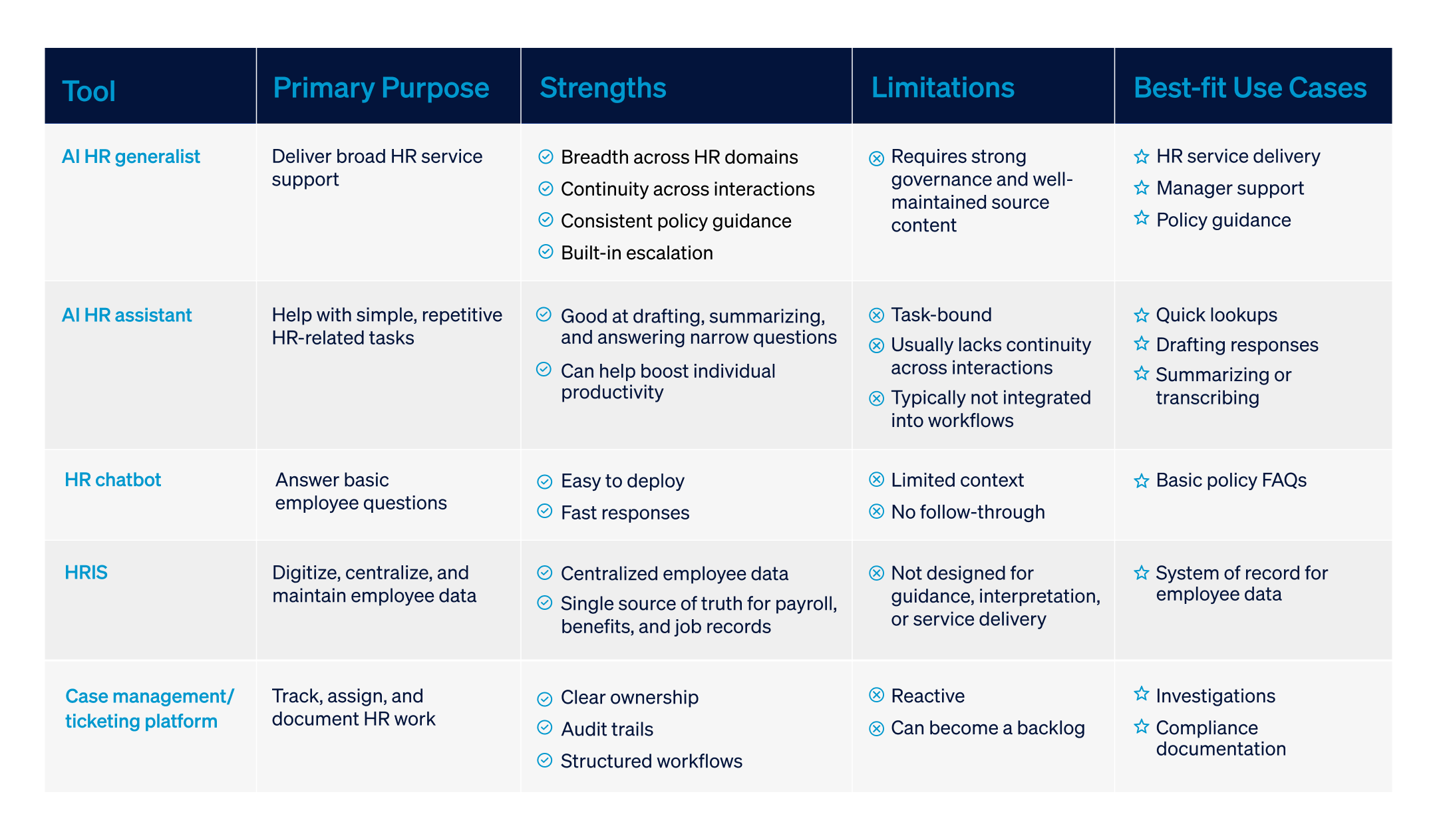
No. Although the terms are sometimes used interchangeably, an AI HR generalist and an AI HR assistant serve different purposes and operate at different levels of scope within HR — as do other common tools, like chatbots and HRIS systems.
Here's how different tools compare:
Can AI HR Generalists Replace Humans?
No, AI HR generalists are not a substitute for human HR professionals, especially in situations that require judgment, empathy, and accountability.
HR work routinely involves sensitive, high-stakes moments: employee relations issues, disiplinary actions, investigations, accommodations, and questions with legal implications. These situations demand human oversight, ethical reasoning, and more contextual understanding than AI can offer. An AI HR generalist is designed to support this work, not own it.
That's why human-in-the-loop operation is necessary when using AI agents in any workflow:
- AI offers speed and cosistency at scale — for routine requests, like policy clarification, process guidance, intake, and routing, AI agents excel at fast, consistent responses that reduce your backlog and avoid variation.
- But you need humans to handle exceptions and risk. When interactions surface potential legal exposure or protected activity, the agent escalates to a human rather than attempting resolution autonomously.
FAQ
1. What is an AI HR generalist?
And AI HR generalist is an AI system designed to support the broad, day-to-day scope of HR work. It helps answer employee questions, guide managers through common people situations, route HR requests, and ensure policy consistency, while escalating sensitive or high-risk issues to human HR teams. It mirrors the breadth of a human HR generalist rather than focusing on a single HR function.
2. Is an AI HR generalist the same as an AI HR assistant?
No. An AI HR assistant helps with more limited, query-based tasks like drafting messages, answering limited FAQs, or summarizing documents. An AI HR generalist has broader scope and continuity, supporting multi-step HR interactions, maintaining context, and operating with HR-safe escalation patterns.
3. What’s the difference between an AI HR generalist and an HR chatbot?
An HR chatbot usually answers isolated questions and relies on predefined responses. An AI HR generalist supports a wider range of HR topics, maintains context across interactions, is able to take action using your organization's tools and systems, and helps move work forward through routing, summaries, and escalation.
4. What kinds of HR questions should AI answer?
AI is well-suited for routine HR questions, such as clarifying a policy, navigating benefits, or arranging leave. Issues involving employee relations, investigations, disciplinary action, accommodations, or legal interpretation should be escalated to humans. Effective AI HR generalists are designed with guardrails that recognize when escalation is required.
5. Can AI HR generalists replace HR teams?
No. AI HR generalists are not replacements for human HR professionals. They are designed to augment HR teams by handling repetitive service work and improving consistency, while humans remain accountable for judgment-heavy, sensitive, and high-risk decisions.
6. What are common risks of using AI in HR?
Common risks include inconsistent guidance, over-automation of sensitive issues, and lack of governance. Teams mitigate these risks by defining clear boundaries, grounding AI in approved sources, requiring escalation for high-risk topics, and keeping humans accountable for final decisions.
7. How does an AI HR generalist help managers?
AI HR generalists help managers by providing just-in-time guidance for common people situations, such as feedback conversations, performance issues, or process questions. They offer structured prompts and policy-aligned guidance, reducing uncertainty while ensuring consistency.


