AI for HR That Reasons, Not Just Responds
Most AI tools look up answers. Harper thinks through cases. The difference is the HR Reasoning Engine: a domain-specific reasoning layer built for HR's case complexity, compliance demands, and auditability requirements.












Other AI platforms aren’t built for HR
There's no shortage of AI tools that can answer a simple retrieval question. The problem is that most HR work isn't a question. It's a judgment call. And when AI gets that wrong, the consequences land on HR.
AI that wasn't trained on HR logic will fill gaps with its best guess, delivered with the same confidence as a correct answer. In HR, a wrong answer about leave entitlement or a termination process is a legal liability.
Most chatbots start every interaction cold. No prior context, no case history. The result is repeated conversations, frustrated employees, and HR cleaning up the mess.
Responding to a question and resolving a case are not the same thing. AI that surfaces a policy link or summarizes a document hasn't done the work. It's simply moved the burden down a step.
AI that lives only inside one system like your HCM can only act and reason within that system. The moment a case crosses systems or touches a third-party administrator, HR still has to fill the gap manually.
Purpose-built reasoning for HR's complexity
The HR Reasoning Engine isn't a single model. It's a system of interlocking components built to handle the judgment, compliance, and context demands that HR work requires.
Trained on HR reasoning patterns, compliance logic, and case handling. Not a general model retrofitted for HR.
Governs what Harper says and what she can’t. Every response is bounded by your policies and multi-jurisdictionally aware.
Built for “messy,” long-horizon, multi-step cases that span multiple people, systems, and days. Not just Q&A.
Context doesn't reset. Harper knows whathappened before: employee history andprior context carry forward.
Harper doesn't just respond, she acts. Read/write capabilities across HRIS, ticketing, and systems of record.
Harper learns from every case. Decisions, escalations, and outcomes accumulate. Harper gets sharper over time.
From the routine to the genuinely complex
Most AI tools top out at simple FAQs. Harper handles the full range, from routine questions to the cases that require deep HR reasoning.

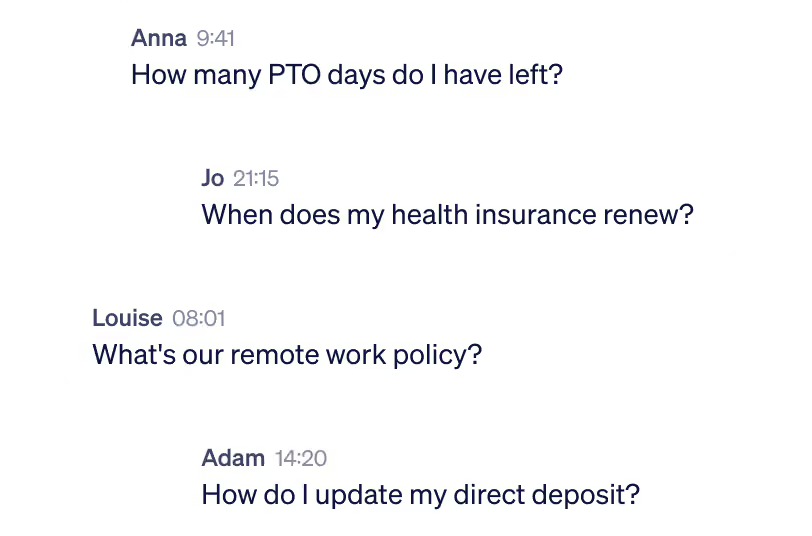
Policy lookups, benefits questions, PTO balances, payroll queries. Harper handles these instantly and consistently, freeing your HR team from the inbox.
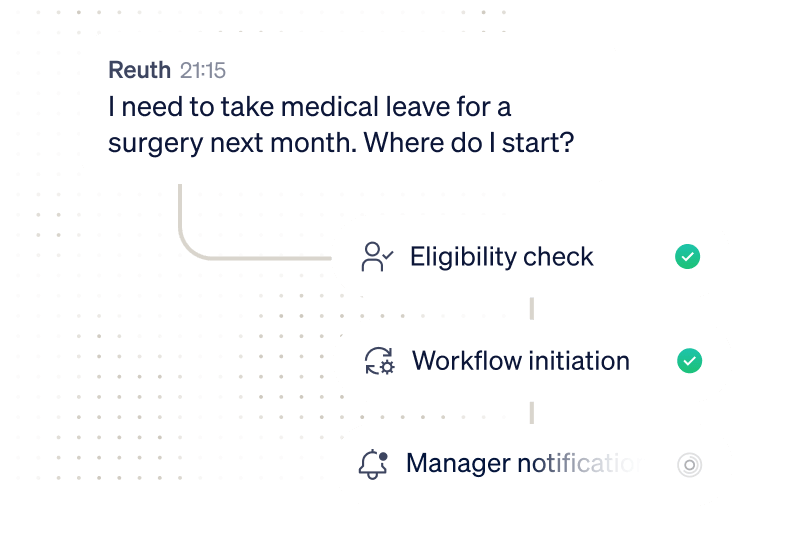
Leave requests, job changes, onboarding, manager escalations. Harper manages these end-to-end: intake, reasoning, cross-system action, and follow-through.
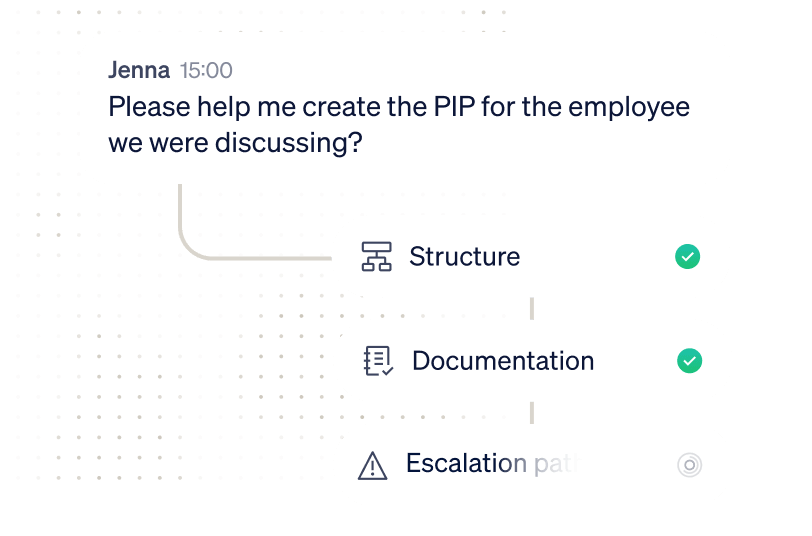
The cases with legal exposure and no room for error. Harper handles intake, documentation, and compliance logic — and hands off to HR when human judgment is required.
Powered by Wisq’s proprietary HR Reasoning Engine
Harper isn’t a general-purpose model told to act like HR. She’s powered by a domain-specific reasoning layer purpose-built for HR’s complexity and stakes.


Head-to-head: where others fall short
Whether you're evaluating an internal build or an AI add-on, the gaps are significant. Here's how they compare.
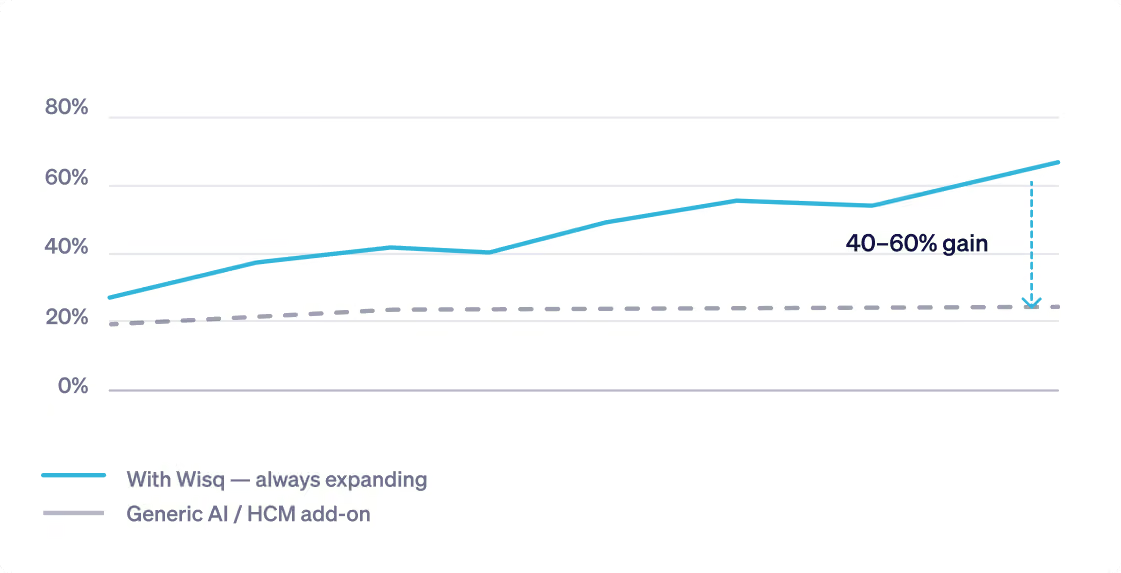
Internal builds can’t keep up. Harper gets better & better
Harper keeps learning, improving, and taking on new workflows over time — giving HR teams greater leverage the longer they use it.

Leave requests, job changes, onboarding, manager escalations. Harper manages these end-to-end: intake, reasoning, cross-system action, and human handoff when needed.
Delivering real value for enterprise HR teams


“Wisq is a strategic investment that drives operational excellence at FICO. By automating routine HR functions, we've shifted our organization toward higher-value priorities while enhancing the employee experience. This allows us to deploy our human capital where it creates the most business impact.”


“Harper gives our team members quick, accurate answers whether it's 2pm or 2am, without our People Services team having to staff a 24/7 operation. That's a game-changer for a company growing as fast as we are.”


“We have employees in Seattle, Las Vegas, the Philippines, and remote, each with different policies and needs. Harper understands that context. An employee in Cebu gets Philippines-specific support; someone in Seattle gets exactly the support they need. We love that we can rely on Harper for that.”
Wisq is designed with security, trust, and reliability built-in from day one.
Awards & recognition



See the HR Reasoning Engine in action
Watch Harper handle a real HR case and see what purpose-built reasoning makes possible.

Frequently Asked Questions
The HR Reasoning Engine is the domain-specific reasoning layer that powers Harper. Unlike general-purpose AI, it was purpose-built for HR's compliance demands, case complexity, and auditability requirements. It combines a family of HR-trained language models, policy grounding, persistent case memory, cross-system action capabilities, and HR-specific guardrails in a single system.
The HR Reasoning Engine is domain-specific and purpose-built for HR reasoning. It allows Harper, our AI HR teammate to reason through cases like an HR professional would, applying compliance logic, retaining employee history, acting across connected systems, and knowing when to escalate. It was trained on HR's reasoning patterns, not the general web, so it handles the judgment-heavy work generic models can't.
Every Harper deployment is grounded in your actual policy documents, employee handbook, and jurisdiction-specific compliance obligations. When your policies change, your Wisq team updates the grounding so Harper always reflects how your company operates, instead of a generic approximation of HR.
Harper is designed to recognize the limits of what it should handle autonomously. When a case requires human judgment — a sensitive ER situation, a complex accommodation, or anything outside defined guardrails — Harper escalates to a human with full context, so HR isn't starting from zero.
The HR Reasoning Engine includes employment law guardrails, protected class sensitivity, and multi-jurisdictional awareness built into the model. Every action Harper takes is logged and auditable. Wisq does not provide legal advice, and as part of implementation, the Wisq team works to validate Harper's configuration against your specific compliance requirements.
Harper includes HR-specific guardrails designed for situations involving protected class information, regulated processes, and high-stakes decisions. These are not generic content filters. They're HR-aware triggers built to flag, route, or decline to act in the specific situations where AI should defer to a human.
Yes. Harper has read/write access to your HRIS, ticketing systems, and other systems of record. As a result, it can complete tasks across your full HR stack, not just inside the conversation. The specific integrations depend on your environment and are scoped during the Autopilot deployment process.
Harper learns from every case it handles. Decisions, context, escalations, and outcomes build up over time, so Harper gets more accurate with each interaction. Your Wisq team also runs continuous evaluations to catch drift and refine performance, so the deployment improves and never stagnates.