AI adoption vs. AI adaptation in HR: a checklist for HR leaders
While many HR teams adopt AI tools, the real value comes from adapting their operating models, roles, metrics, and governance to fully integrate agentic AI into how HR work gets done.

When some HR leaders talk about AI, they focus on adoption. Rolling out a chatbot. Running a pilot for performance feedback summaries. Automating parts of recruitment or onboarding. But adoption is only the beginning — the act of bringing the tool in the door. Adaptation is what happens next: the structural, behavioral, and cultural rewiring that determines whether AI actually creates value or quietly fades into "that tool we tried last year."
And that gap is where a lot of teams get stuck.
According to Gartner, GenAI adoption in HR rose from 19% in mid-2023 to 61% by January 2025. But if teams aren't seeing measurable productivity or engagement gains, they may not view their AI investments as sustainable long-term.
The reason isn't the tech. It's that yesterday's org charts, SLAs, and metrics aren't necessarily built for a world where agentic AI can answer policy questions, help manage goal setting and performance management, analyze conversations to spot data and trends, and feed insights back into workflows. The way HR measures work hasn’t kept pace with how work is actually getting done—with AI agents now in the mix, legacy metrics are misaligned and misleading.
To close the gap, HR teams need to know what AI adaptation looks like in practice, including the operating model shifts, role changes, and governance frameworks that move AI from pilot to sustainable performance. That's what we'll cover here, plus a checklist to evaluate whether your team is structured to benefit from agentic AI, not just buy it.
What's the Difference Between Adoption and Adaptation?
Many HR teams start with adoption because it's the easy part. You can point to a chatbot or workflow and say, "We're doing AI." It checks a box. It satisfies a board question. It even might make life a little easier for employees who'd rather ask a bot than wait for an email response to a question.
But adoption alone doesn't change how work gets done.
Adaptation requires HR teams to start rewriting their processes, decision loops, and accountability models around AI, so the technology isn't just added on, it's built in. It's the difference between deploying a bot to answer questions and redesigning your employee support function so that AI handles 80% of Tier 1 inquiries, while humans focus on exceptions, coaching, and strategic work.
Put another way:
- Adoption = introducing AI tools, deploying chatbots or automation, and running pilots
- Adaptation = rethinking processes, roles, metrics, governance, ownership, decision rights — reorganizing to let the AI agent be part of the fabric
McKinsey's 2024 State of AI report showed that 65% of responding organizations were already regularly using generative AI at the time. McKinsey also noted that companies were also beginning to redesign workflows and elevate governance to capture value, with workflow redesign correlating with greater financial impact from AI deployments.
The latter insight is key: The organizations that see the biggest returns from AI are those that don't stop at adoption. They go further, into how work flows, who makes decisions, and how AI and humans co-operate, and then they reap the benefits of their adaptation strategies.
What Does Adaptation Look Like In Practice?
Adapting to AI means redesigning the gears of HR so that humans and agents work together, seamlessly and sustainably — in other words, an operational shift, not just a change in mindset. Many teams stall out because they adopt a tool, automate a few tasks, and then hit the limits of their old structure.
Real adaptation happens when HR rewrites how work gets done, including who owns what, how decisions are made, how success is measured, and how learning loops feed back into the system.
Here's what that looks like across six systems:
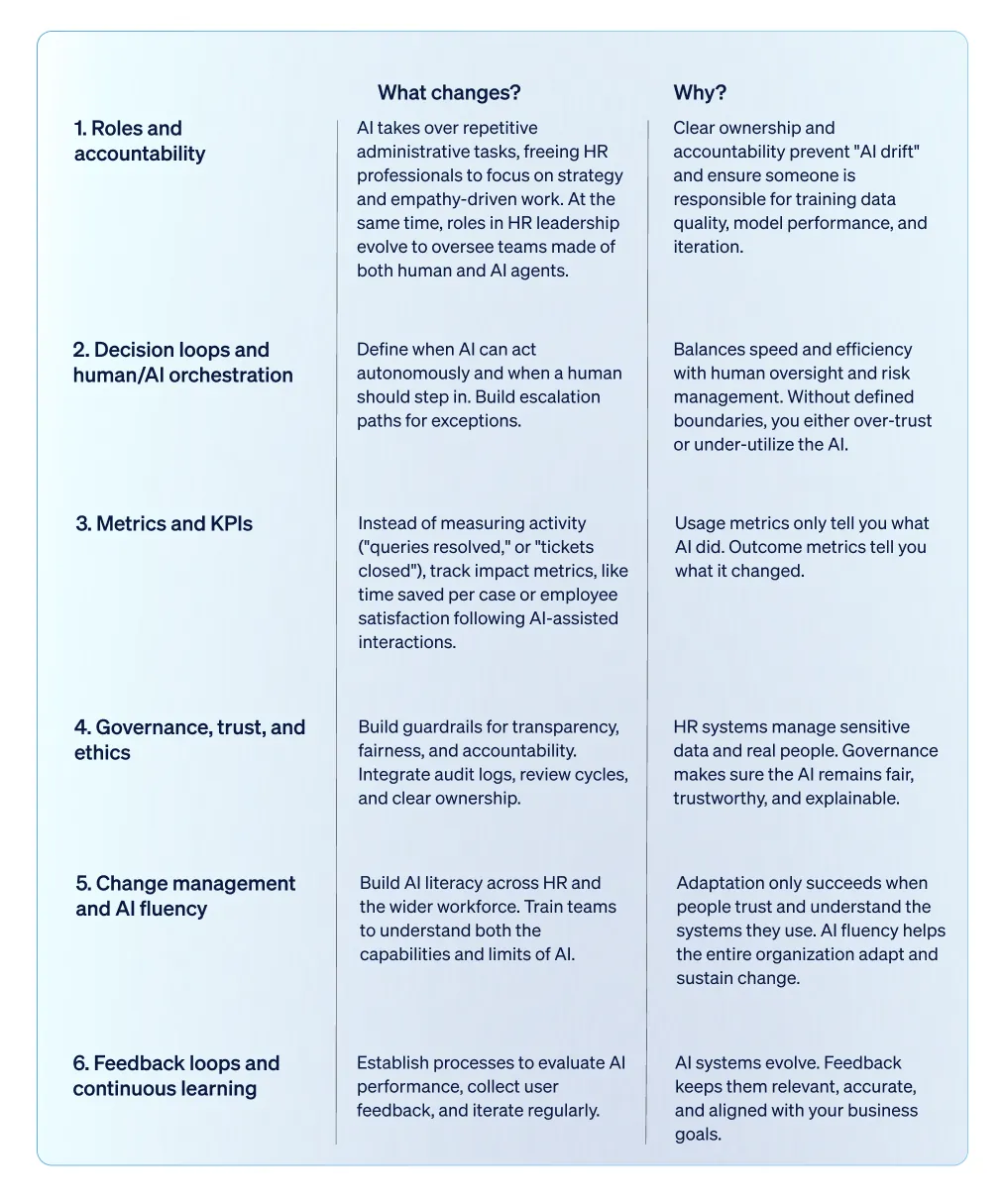
Adaptation isn't a one-time project. It's a new operating rhythm that incorporates AI into your organization's everyday. Each of these six dimensions feeds the others; when ownership is clear, decisions are faster. When metrics measure outcomes, governance has teeth. When feedback loops run smoothly, trust grows. Together, they form a foundation for HR teams to thrive alongside AI.
From Adoption To Adaptation: Checklist for HR Leaders
Think of AI adaptation like a sequence, where each step builds on the ones before it. This checklist has three parts: First, you set the foundation for AI adoption and adaptation, then you redesign the work, and finally, you scale so AI becomes sustainable over time.
Set the Foundation
1. Establish an AI governance council
Bring together stakeholders from HR, IT, legal, and operations to define oversight, transparency standards, and escalation paths. Shared governance builds trust and reduces compliance risk. Without it, AI tools can drift or introduce bias unnoticed.
2. Assign clear ownership within HR
Designate an HR AI product owner, or AI lead, accountable for the design, data quality, and performance of every deployed model.
This prevents AI tools from becoming "orphans," or tools launched with enthusiasm but no ongoing accountability.
3. Map your decision boundaries
Define actions AI can take autonomously (such as approving standard PTO requests) versus where a human review is mandatory. This clarifies the balance between efficiency and oversight and ensures the AI makes consistent, defensible decisions.
Redesign the Work
4. Redefine HR roles for a combined human and AI workforce
Update job descriptions and workflows so employees know which responsibilities have shifted to AI agents and where human judgment still adds value. This prevents duplication and resistance, while freeing HR professionals to spend their time where it matters more: strategic and empathy-driven work.
5. Align KPIs to outcomes, not activity
Replace vanity metrics (like "tickets resolved") with value metrics (like "employee satisfaction," "resolution rate," or "HR hours saved"). This aligns performance measurement with business outcomes, not tool usage.
6. Build AI fluency and change readiness
Train HR teams and other users on AI's capabilities and limitations. Develop "AI champions" who model best practices and advocate for adaptation. Fluency sustains long-term use and empowers employees to partner confidently with AI systems, driving adaptation metrics.
Sustain and Scale
7. Embed continuous feedback loops
Collect user feedback, track drift, and review performance on a regular cadence (at least quarterly). Adjust prompts and workflows and, if needed, retrain models based on feedback.
This keeps your AI tools relevant and aligned with your business needs, even as they shift over time.
8. Iterate governance
In addition to auditing AI tools themselves, treat oversight as a living framework. Regularly review your policies, retrain teams, and revisit safeguards, especially as capabilities mature.
Your AI system needs to remain compliant, explainable, and trusted, even as new AI tools emerge (because they will). These strategies will put you on that path.
9. Scale what works
Once governance, metrics, and feedback loops stabilize, expand AI into new areas, like performance, learning management, or people analytics. Codify your best practices as you go. This builds a repeatable AI playbook for safe, effective AI growth across your organization.
A Structural Advantage: Building HR That Learns With AI
The real competitive edge in HR won't come from who adopts AI first; it'll come from who adapts fastest. Tools are easy to buy, but systems that learn, iterate, and scale are much more difficult to build. That's the new leadership challenge we're all facing.
Agentic AI changes the nature of the challenge. It demands a new HR operating system, not just new tools. When agents like Harper, Wisq’s AI HR teammate, can act autonomously to triage issues, facilitate processes, and more, the question isn't "should HR use AI?" It's "is HR structured to use AI well?"
Adaptation gives HR the muscle to govern AI responsibly, the fluency to partner with it confidently, and the systems to measure its impact meaningfully. At Wisq, we've seen that when HR teams design around agents, the returns compound. Workflows get faster, employees get better answers, and leaders get cleaner insight into what's working across the organization.
The smartest path forward is amplifying HR through AI adaptation. The teams that start redesigning now will define the new standard for what modern HR looks like.
Frequently asked questions
What is AI adaptation in HR?
AI adaptation is the process of rewriting HR's processes, decision rights, and metrics so AI functions as part of daily work. It includes redesigning roles, aligning KPIs to outcomes instead of activity, and building feedback loops that keep AI tools accurate as needs change.
What is the difference between AI adoption and AI adaptation?
Adoption means bringing AI tools in: deploying a chatbot, automating a task, running a pilot. Adaptation means changing how work gets done around those tools, including who owns decisions, how performance is measured, and how governance works.
What is an AI governance council in HR?
An AI governance council brings together stakeholders from HR, IT, legal, and operations to set oversight standards, transparency requirements, and escalation paths for AI tools. It gives the organization a way to catch bias or drift before it affects employees.
How is AI adaptation measured?
AI adaptation is measured with outcome-based KPIs rather than usage metrics: employee satisfaction, resolution rate, and HR hours saved, instead of tickets resolved. Feedback loops reviewed at least quarterly track whether those outcomes are improving.
Who should own AI tools within HR?
Each AI tool needs a named owner, typically an HR AI product owner or AI lead, accountable for its design, data quality, and ongoing performance. Without a named owner, tools tend to launch with enthusiasm and then go unmanaged and unmeasured.