Before You Pick an AI Tool, Do This: Jarlath Doherty on Getting HR Ready for AI
Seasoned HR executive Jarlath Doherty on why tier one employee support is the right place to start with AI, why data readiness is more urgent than most HR leaders think, and what it actually means to bring a product mindset into a people function.

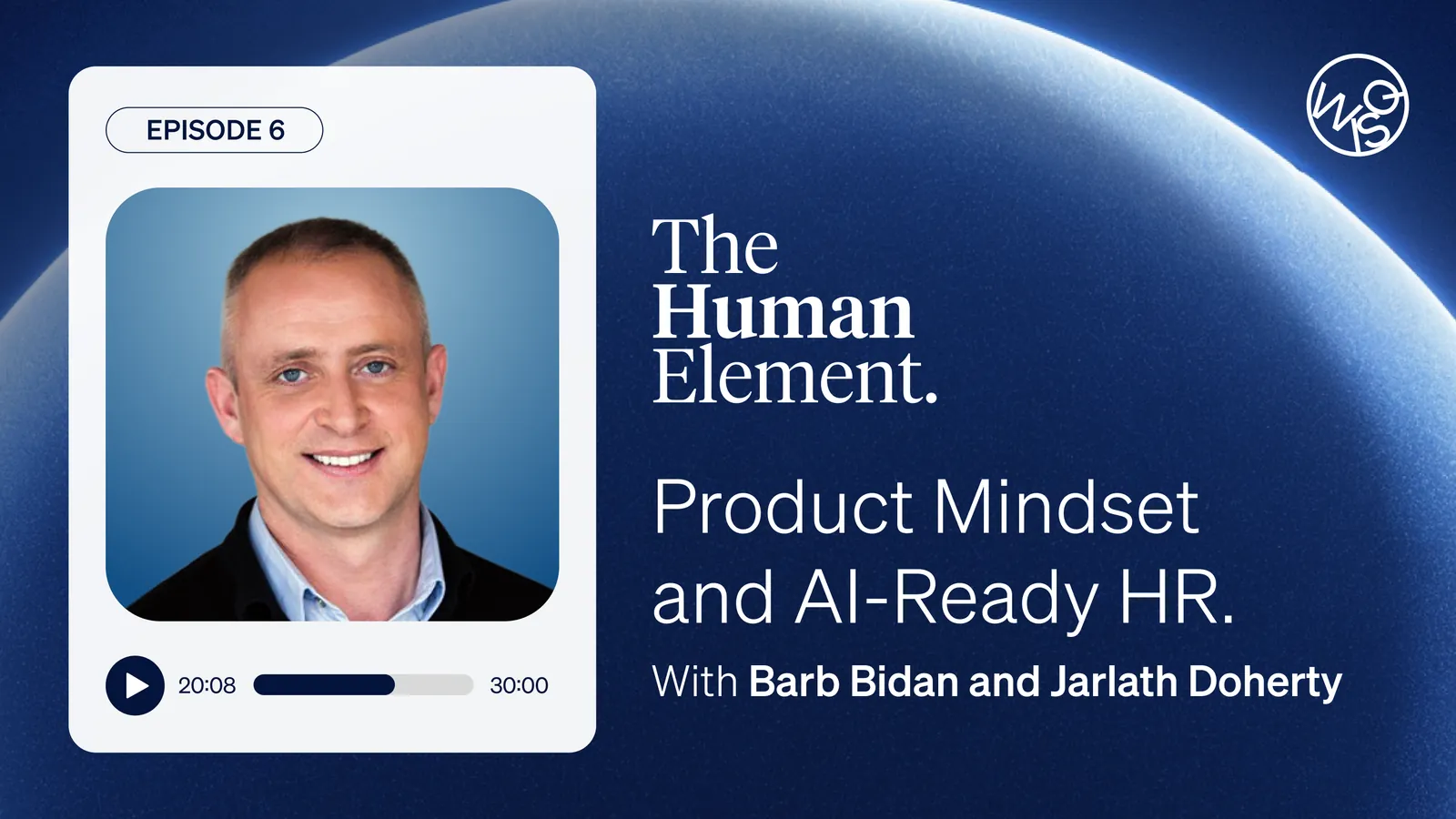
The Human Element, presented by Wisq, is a podcast hosted by Barb Bidan where CHROs and senior HR leaders share candid stories and practical perspectives on how AI and innovation are shaping the future of HR. In this episode, Barb sits down with Jarlath Doherty, a seasoned HR executive who has led global people and operations functions at Squarespace, Collibra, LinkedIn, and Yahoo, and serves as a board member at Kinore in Ireland. They talk about where to start with AI, why your data is probably less ready than you think, and how the HR operating model is being fundamentally re-architected. Subscribe today.
Jarlath Doherty is not a typical HR voice on AI. He started his career as a junior engineer building data transformation middleware, spent seven years as Chief People Officer at Calibra, a data analytics and governance company, and has spent the last several years at Squarespace leading not just the people function but also internal communications and events. When he talks about data readiness, garbage in garbage out, and the product mindset HR teams need to develop, it is not theoretical. It is the thread that has run through his entire career.
His perspective on where HR leaders should focus right now is direct: start with tier one frontline employee support, get your data house in order, and stop waiting for the perfect tech stack before you begin.
Start with Tier One Support
When asked which AI use case every HR leader should pilot this year, Doherty does not hesitate. "It is absolutely the tier one frontline employee support. Maybe we call it the chatbot or your ticketing service. I think that's where everybody should be experimenting right now."
The logic is straightforward. Every HR team, regardless of size or structure, handles a high volume of routine queries. These are important to the individual asking, but they consume disproportionate HR resources and are often the same questions answered over and over. The episodes Doherty references from earlier in the podcast season make the case with numbers: organizations have cut first response times by 50, 60, even 80 percent without a human touching the interaction.
The downstream effect is the real prize. "If you could automate 40% of the operational workload that you're doing across your organization, you are literally doubling the capacity that you have in the team." That capacity is what gets redirected to the work AI cannot do: coaching a struggling employee, mediating a workplace conflict, designing a culture that actually inspires people. "There's no algorithm or decision engine or AI tool right now that can coach a struggling employee on an issue that they're having." The point of automating tier one is not efficiency for its own sake. It is freeing up the human judgment and empathy that matters most.
The Data Problem Most Teams Are Not Ready For
Doherty's engineering background makes him more candid than most about what actually has to be true before AI delivers on its promise. The phrase he uses is a version of an old one: garbage in, garbage out.
His team at Squarespace felt confident about their data. They had invested heavily in consolidating their HR tech stack. They ran a rigorous process: a longlist of 70 tools, narrowed to 20, taken down to 10, piloted across the organization. And then the surprises started appearing. "We actually only launched Workday two and a half years ago, and there were two other systems in the building before that, and none of that data is now in our data model."
The problem is not just structured data in HRIS systems. It is everything. "How many of us have intranets or Jira sites where you have 10 versions of a policy that the old nine were never deprecated? You do a search in your toolbar and you get six different versions of the same thing coming up." When a chatbot pulls from conflicting policy documents, it does not just give a wrong answer. It erodes trust in the entire AI program.
His reframe of what "data" means in an AI era is worth holding onto. In this context, data is not just numbers in systems. It is every policy, every handbook document, every piece of content employees search for or reference. All of it feeds the model. All of it needs to be current, accurate, and governed. "Do the hard work now. Establish the governance, build the foundation. Your future AI-powered HR function will thank you, and you do not need to wait to start."
The Product Mindset HR Teams Need
One of the most practical things Doherty did at Squarespace was stand up cross-functional pods to tackle AI use cases, bringing together people from talent management, HR tech, people analytics, HR business partners, and legal. The insight that came out of it was not what he expected.
"The people that we thought were the product managers were in fact not the best placed for that project." Watching who actually thrived in those pods, who could think in user stories, define requirements, and iterate quickly, changed his view of which skills matter most right now inside an HR function.
His argument is that HR teams need to start thinking like product teams. Employees are users. Their journeys through HR processes are products. The role of an employee experience designer, borrowing from product management and UX principles, is not a future concept. It is already emerging. So is the AI operations specialist, the person who configures, optimizes, and governs the systems being deployed, making sure they are giving accurate answers and evolving as the organization does.
Neither of those roles existed in traditional HR structures built around shared services, HRBPs, and centers of excellence. "That model is very much breaking as we start to look at the use of agents through workflows rather than specific roles."
Data Fluency Is the Underrated Skill
When asked for the most underrated skill for HR leaders in an AI era, Doherty's answer is data fluency, across every member of the people organization, not just the data scientists.
"I think that data fluency in the world that we're walking into on every member of your people organization is going to be a critical part of you being able to leverage and really bring that value proposition." This is not about turning HR generalists into engineers. It is about building a collective understanding of data quality, governance, and what it means to load a model with information that is accurate and current. It is also about the rigor required to audit algorithms, catch bias, and govern what is being deployed.
The organizations that treat this as an IT problem, or as someone else's job, are the ones that will discover their AI investments are underperforming because nobody owned the foundation.
What a Data-First HR Leader Actually Uses
Doherty's personal go-to is Claude. "I'm really leaning into the Claude side of the house. I would say Claude, followed by ChatGPT. Over the last three or four months, that's been my go-to, and it's changed the way that I work. It's changed the way that I do everything."
His closing advice for HR leaders just starting out:
"Do the hard work now. Clean your data. And by data, I mean it is policy, it is a document, it is everything that is currently in use that employees and managers have access to, that they use or seek or search for."
Every AI tool, regardless of which one you choose, will require that foundation. The leaders who build it now will move faster than everyone who waits.
To hear more conversations like this one, subscribe to The Human Element wherever you get your podcasts.