Lead with Your People: Acelero Learning's CPO on Why Trust Is AI's True Currency
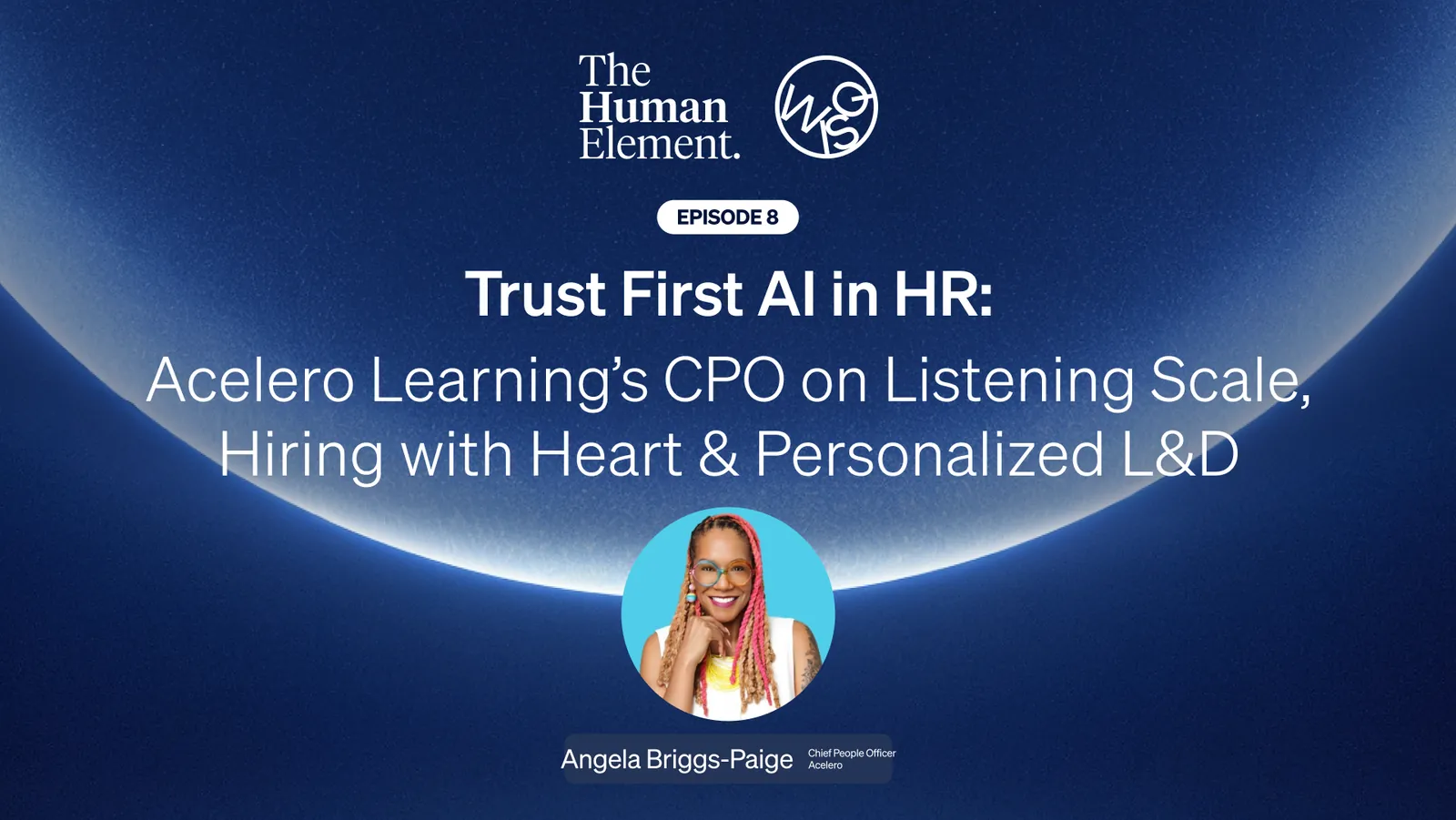
Acelero Learning Chief People Officer Angela Briggs-Paige on using AI to listen at scale, the golden rule that governs every hiring decision, and why adoption fails the moment employees think AI is coming for their jobs.

The Human Element, presented by Wisq, is a podcast hosted by Barb Bidan where CHROs and senior HR leaders share candid stories and practical perspectives on how AI and innovation are shaping the future of HR. In this episode, Barb sits down with Angela Briggs-Paige, Chief People Officer at Acelero Learning, a national organization dedicated to expanding access to high-quality early childhood education. They talk about AI-powered employee listening, mission-driven hiring, and why trust is the only currency that makes adoption actually work. Subscribe today.
Angela Briggs-Paige has a three-word rule that governs every AI-assisted hiring decision at Acelero Learning: "AI recommends, humans decide." It is simple enough to put on a wall, and specific enough to actually guide behavior. For an organization working to expand access to early childhood education, where the work is emotionally demanding and chronically underfunded, that clarity is not optional. It is the whole philosophy.
Briggs-Paige leads people strategy, organizational development, culture, DEI, and learning and development at Acelero Learning. She is also a Head Start alumna herself, which is not a small thing. "I am a Head Start kiddo," she says. "So we want to make sure that we are bringing in people that are so aligned to our mission." When she talks about hiring with heart, it is personal.
Listening at Scale
The biggest impact AI has had at Acelero is not what most people would expect. It is not onboarding automation or case management workflows. It is employee listening.
Acelero runs quarterly surveys to understand how employees are really doing. The problem was that the volume of responses was burying the team. "We had thousands of comments, and there's no way that we could get to all those comments and be able to provide a readout in a timely session." By the time the analysis was done, it was time to launch the next survey.
AI changed the timeline entirely. "AI really helps us understand what people are saying within hours instead of waiting for weeks." And it goes beyond speed. The tool picks up tone, emotion, and patterns the team might have missed. It tracks how sentiment is shifting over time, not just what people are saying right now but how that is changing.
The humans still do the listening. They still read the comments. AI clears the noise so the team can focus on what actually matters: the story behind the data. Leaders can now have conversations while feedback is still fresh, which is how trust gets built. "There's nothing worse than someone taking a survey and then not seeing any action on that."
The capacity that freed up went somewhere deliberate. Instead of manual coding of spreadsheets, Briggs-Paige's team is redesigning onboarding so it feels like a genuine welcome rather than paperwork, building coaching and career pathway conversations that happen more than once a year, and focusing on what actually makes the people function feel human.
Hiring with Heart
Early childhood education is one of the harder hiring environments in the country. The candidate pool is small, burnout is real, and Acelero is competing with Target, Amazon, and Starbucks, companies paying $18 an hour with benefits "where nobody bites you during your shift." The posting-and-praying strategy stopped working a long time ago.
AI handles the baseline screening: credentials, compliance requirements, state licensing, eligibility to work. All the boxes that have to be checked before a real conversation can happen. That part is well suited to automation and it frees recruiters for the work that is not. "It can't tell us if someone has the heart for this work. It can't pick up the warmth in someone's voice when they talk about why they want to work with children."
The golden rule holds firm throughout: AI recommends, humans decide. No hiring decision comes from an algorithm. What AI does is get the team to the right conversations faster, with better job descriptions, more targeted interview questions, and postings that actually sound like Acelero, values-driven, inclusive, and mission-aligned.
Personalized Learning, Built for Curiosity
Learning is where Briggs-Paige is most energized, and most candid about where things stand. Acelero is in the early stages of piloting AI to build personalized learning plans for employees and leaders. She is not claiming to have it figured out. "We built a bot. We're seeing how it works. We're experimenting. We're still listening."
The vision is clear even if the execution is early. A system that looks at someone's role, their goals, and the feedback they have received, then curates a learning path that fits their actual growth needs. A leader working on coaching might get micro-learnings on feedback conversations or a connection to a peer mentor. The old model of everyone going to the same training at the same time is what this is replacing.
Success is not yet measured in percentages. The signals Briggs-Paige is watching are engagement: are people using the content, are they saying it actually fits them, are leaders referencing their learning in team meetings. The goal is to make professional development a daily practice rather than a periodic obligation. "We're building a culture of curiosity around how this can work."
Trust Is the Currency
The biggest obstacle to AI adoption at Acelero was never technical. It was psychological. "If people believe even for a second that AI is coming for their jobs, adoption will fail. It doesn't matter how good the tool is. It doesn't matter how much training you provide. People will resist, or they'll quietly sabotage, or just refuse to engage."
Briggs-Paige's response was to make AI use normal. The executive team modeled transparency, openly sharing when and how they used AI, what worked and what did not. No shame, no secrecy. The organization also built a group of change champions, people who were naturally curious, who piloted tools and brought their experiences back to peers. Adoption took root when colleagues saw colleagues using it, not when the people team announced it.
ROI gets measured in two ways: capacity and culture. Is it saving a director time on coaching? That is ROI. Are people spending more time in human, high-value moments? That is winning. The goal is to build capacity without replacing connection.
The misconception she pushes back on hardest is that buying the right platform will make adoption happen. "I believe AI adoption is about trust, period." The tool is the easy part.
Lead with Your People
Her closing advice for HR leaders starting their AI journey is built around a single question to ask before doing anything else, before buying a platform, attending a conference, or drafting a policy: "Would this help me care for people better?"
If the answer is yes, the process that follows is simple. Find one pain point. Find a tool that helps. Pilot it. Learn. Adjust. Share what you learned. Then do it again. "You got to start by solving real problems for real people."
"We didn't get into HR to optimize systems. We got into it because we care about people." For Briggs-Paige, that is not a closing sentiment. It is the whole framework.
To hear more conversations like this one, subscribe to The Human Element wherever you get your podcasts.