Rebuilding HR for the AI Age
Most HR teams are adopting AI tools, but almost none are restructuring for them. With only ~2% of HR job postings requiring AI skills, organizations are about to face a structural gap: AI is transforming workflows faster than HR is evolving. This piece explores how HR roles, org charts, and operating models must be rebuilt for a future where humans and AI agents work side by side.

Only around 2% of HR job postings currently list AI-related skills as a requirement. That number is shockingly small when you consider how much of HR's day-to-day work is already being reshaped by intelligent systems. Recruiting, onboarding, compliance, performance management — these are just some of the areas AI is starting to redesign.
The gap is telling: HR is integrating AI tools, but it hasn’t redesigned for them. That structural lag puts companies at a disadvantage.
It's a bit of a paradox: HR operations are evolving rapidly, now that AI agents can handle routine queries, monitor performance signals, and automate recruitment workflows, but the way we staff and organize HR departments hasn't changed much in decades. When a position opens up, most of us still find ourselves reaching for an "HR generalist," not an agent.
That inertia comes with risk. As AI agents become capable of executing cross-system tasks, the classic model of scaling HR by adding human headcount becomes more and more outdated. Why add more people to chase the same manual work, when an AI agent can absorb much of it, freeing human partners to focus on coaching, strategy, and culture?
The core structure of HR hasn't been challenged in a long time, but AI is making the old model look increasingly obsolete. The question isn't whether to bring AI into HR (and if you haven't, you're likely already falling behind). To truly stay competitive, HR teams will need to restructure from the ground up, and who comes out ahead is likely to depend on how fast you're willing to rebuild.
AI Is More Than a Tech Trend — It's Changing How HR Must Be Organized
The mistake many companies make is thinking AI can be bolted on to their existing HR function. Buy a tool, roll out some training, call it a day.
But that approach misses the bigger picture. AI isn't just another system in the HR tech stack. It's a force that's reshaping how entire industries are structured, how roles are defined, and how functions operate within businesses, including HR.
Why? Because the workflows AI enables don't necessarily map neatly onto the org models HR has relied on for decades. Consider how an AI agent can triage employee questions, proactively flag compliance risks, or suggest recruitment candidates based on data patterns. You aren't just changing how fast the work gets done — you're changing who does it, how decisions get made, and where human judgment is most valuable.
To stay competitive, HR leaders need to think in terms of:
- New roles: Functions like AI agent managers, data ethicists, and AI-enabled people analysts are becoming standard. In LinkedIn's 2025 Jobs on the Rise report, 60% of the jobs are new to the list this year and around half didn't exist 25 years ago. "Artificial Intelligence Engineer" tops the list, and for the second year in a row, AI-related jobs are the fastest growing category.
- New partnerships: HR can't operate in a silo in the AI era. Stronger collaboration with IT, Legal, and Finance is essential, not just to manage risk, but to design cross-functional workflows where AI touches multiple systems.
- New workflows: Instead of employees waiting on tickets or endless email chains, AI-enabled HR can deliver support faster and more efficiently (often in real-time). But that means many HR processes need to be rebuilt for speed, scalability, and transparency.
This is bigger than upskilling a few people on prompt engineering or rolling out a new software license. HR must determine what work is human, what is agent-led, and how the two combine to create greater impact.
How HR Team Structures Are Changing
When you look at existing job postings, you can already see how AI is being woven into HR — not as a wholesale replacement for traditional roles, but as a layer of capability that requires new responsibilities and new types of leadership:
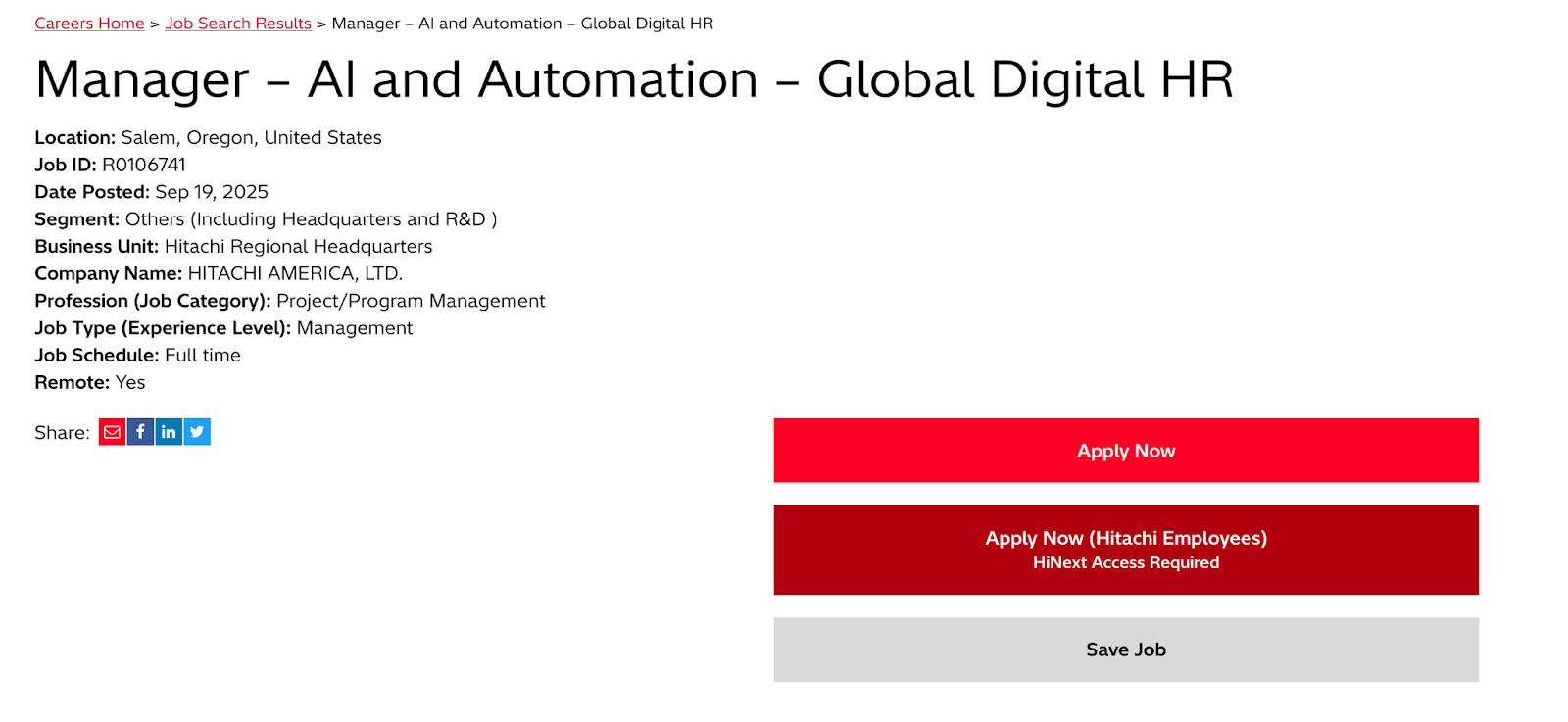
- Manager, AI and Automation, Global Digital HR at Hitachi: This role asks for a candidate to lead global AI and automation initiatives within HR, showing how large enterprises are formalizing AI oversight as a core part of their HR strategy.
- People Strategy & Operations Manager, Valence: Here, AI is part of operational excellence — the role emphasizes using automation to improve processes, workflows, and strategic decision-making across the people and recruitment functions.

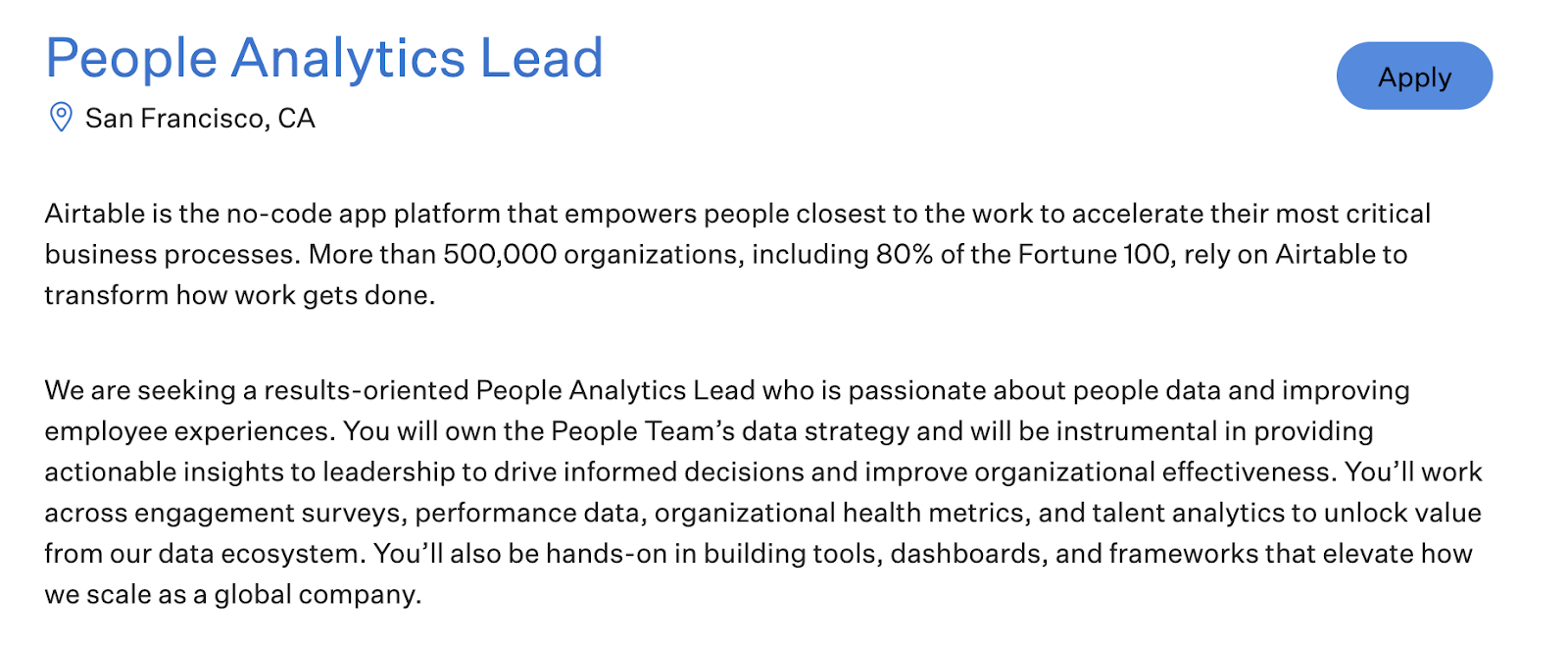
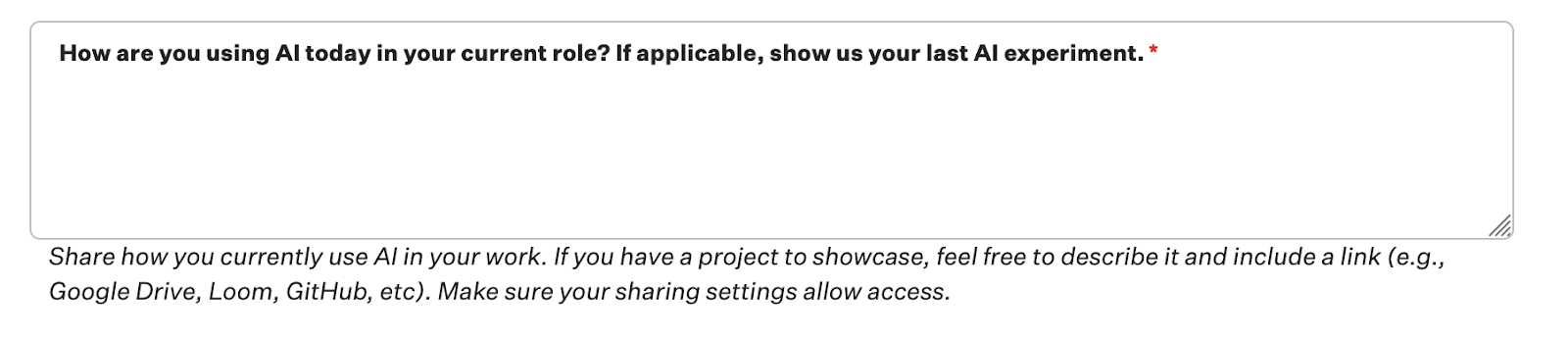
- People Analytics Lead, Airtable: Analytics isn't new, and this role's description doesn't explicitly mention using AI on the job. But what's notable is the application that asks candidates to describe how they use AI in their current projects or role, showing that Airtable is looking for applicants who are forward-thinking about how to embed AI technology into their day-to-day.
Taken together, these roles all point to a pattern: HR roles certainly aren't disappearing, but they're evolving, blending traditional people expertise with new responsibilities around data, automation, technology, and governance.
The Future HR Org Chart
Looking ahead, we can start to imagine what the HR team of the future might look like if AI becomes embedded at the core of how the function operates:
- AI-enabled HRBP: The HR Business Partner role isn't going away, but it's being redefined. Tomorrow's HRBP will manage both people and AI agents, while using increased capacity to spend more time on judgment, strategy, and culture.
- People data and analytics lead: While already a common role, expect its scope to expand dramatically as analytics continue to shift from descriptive (what happened) to predictive (what's likely to happen). This role will become central to workforce planning, retention, and leadership development.
- Employee experience and automations manager: Employee experience has always been an HR priority, but AI agents mean the role will blend experience design with workflow automation to ensure the moments that matter (onboarding, performance reviews, etc.) feel seamless because AI is quietly orchestrating the back end.
- AI and technology manager: Whether housed in HR, IT, or People Ops, this role will oversee how AI tools are implemented, governed, and continuously improved. It's part change management and part governance, helping both employees and managers understand how AI is and will continue to shape the workplace.
While these roles are still a bit speculative, the important thing is to recognize that, more and more, AI is becoming a teammate, and that's changing the shape of HR teams. Leaders who proactively redefine roles will see their HR functions better aligned with the needs of a changing workforce.
Strategic Implications for Today's HR Leaders
As HR structures evolve, so too must the priorities of CHROs and HR directors. For decades, the playbook has been clear: When workload went up, so did headcount. But if part of your team's capacity can now come from intelligent agents, the definition of "scaling" changes dramatically.
Structural shifts change what HR leaders can (and should) focus on:
- Less time on transactions, more time on strategy: Leaders who once spent hours chasing administrative bottlenecks now need to redirect that time toward higher-value work, like governance, workforce design, strategic coaching, AI upskilling, and managing agents.
- Redefining headcount planning: When some of your HR team's capacity is delivered through agents, headcount planning takes on new complexity. Instead of thinking purely in terms of FTEs, CHROs will need to factor in digital capacity alongside human talent, which means building staffing plans that assess what kind of capacity is required for each initiative, along with how many.
- Leading hybrid human-agent teams: Perhaps the biggest cultural shift is preparing managers to lead hybrid teams. A 2024 Gartner report found that 75% of managers said they were already overwhelmed by growth in their responsibilities. Adding AI to the mix without guidance risks creating more confusion, not less.
While major, these structural shifts aren't optional. Companies that start building agent-integrated HR teams now will move faster, support employees more effectively, and stay leaner than those who cling to traditional models.
How To Start Reshaping HR Teams Today
There are tangible steps HR leaders can take right now to start moving toward a more AI-enabled function, even if the shift feels daunting:
- Audit your current structure against market signals: Start by comparing your existing HR roles with the kinds of postings showing up across the industry. An audit gives you a baseline and helps you see gaps before they become bottlenecks: Are you over-indexed on administrative roles that could soon be automated? Do you have emerging competencies like data analytics represented on your team?
- Identify where agents can take on admin work: Map the high-volume, low-complexity tasks eating up your HRBPs' time. Could an AI agent handle PTO requests? Compliance training reminders? Every hour an agent handles is an hour your people can shift to workforce planning, manager coaching, or employee experience.
- Pilot hybrid roles: Don't wait for a new job family to be created — expand the scope of roles you already have. A People Analytics Lead can become an AI-enabled People Analyst by piloting predictive models that forecast turnover or skills gaps. This lets you experiment with AI responsibilities and gives employees a chance to grow into new areas, building skills before they become table stakes.
- Integrate AI governance into existing functions: Don't separate AI into a silo. AI governance — ensuring fairness, compliance, and transparency — should be baked into existing HR tech and People Ops functions. Your HRIS admin can audit agent activity logs, or your People Ops team can create escalation protocols for when agents hand off to humans. This keeps governance close to the work.
To reshape HR for the AI age, don't scrap what you've already built — layer in new capabilities, step by step. Small moves today will make your team more resilient tomorrow — and position HR as the function that leads your organization confidently into the AI era.
Structural Changes Will Keep HR Teams Competitive
The question for HR leaders isn't whether to use AI. That's a given.
What you need to ask yourself is whether your team is structured to use AI strategically, responsibly, and competitively. Yesterday's org chart, designed for manual processes and transactional scaling, won’t win tomorrow’s talent wars.
AI agents aren't here to replace HR; they're here to create space. And by taking on repetitive work, agents free HR's capacity for the responsibilities only humans can deliver. So the real differentiator won't be who adopts AI first. It will be who rebuilds their teams to make the most of it; to upskill their HR leaders and design for human-agent collaboration. Those that don't risk being left with bigger headcount and smaller impact.