What Are Agentic Workflows? How They Work, Key Patterns, and Real-World Examples
A guide breaks down how agentic workflows actually work, the design patterns behind them, and where they're making the biggest impact — with a close look at what they mean for HR.
Most automation works well — right up until something unexpected happens. A leave request comes in from an employee who lives in a state with its own family leave law. A benefits question requires pulling context from three separate systems. Traditional automation works like this: If X, then Y. But as soon as a process requires judgment, like interpreting context or weighing options to decide the next step, basic automation flows can get stuck.
That's the gap agentic workflows are built to close.
An agentic workflow is an AI-driven process where autonomous agents make decisions, take actions, and adapt in real time to complete multi-step tasks with minimal human intervention. Instead of following a script, they use large language models (LLMs) to reason through complexity, select the right tools, and adjust their approach when conditions change. They don't just execute; they think through problems the same way a skilled team member would.
AI researcher Andrew Ng and his team found that wrapping GPT-3.5 in an iterative agentic workflow boosted its performance on a widely used coding benchmark from 48.1% to 95.1%, allowing it to outperform even the more advanced GPT-4. The experiment showed that the workflow had more impact on the output than the model.
Gartner has predicted that by 2028, at least 15% of day-to-day work decisions will be made autonomously by AI agents — up from essentially zero in 2024. It's already happening; McKinsey's 2025 State of AI report found that 62% of organizations were already experimenting with agentic AI, and nearly a quarter were actively scaling them.
For HR teams, who sit at the intersection of high-volume employee requests, complex policy interpretations, and cross-system coordination, agentic workflows have the potential to be extremely powerful. An AI teammate able to reason through an employee's circumstances, take action across systems, and know when to loop in a human could unlock powerful productivity and capacity gains for HR, without proportionately inflating headcount.
This guide breaks down how agentic workflows actually work, the design patterns behind them, and where they're making the biggest impact — with a close look at what they mean for HR.
What Are AI Agents?
AI agents combine LLMs for reasoning with tools for interacting with the real world, enabling them to plan, decide, and act on complex tasks.
If you've used a chatbot that answers FAQs or a copilot that helps draft emails, you've interacted with AI — but not necessarily with an agent. The difference is that agents own entire tasks from start to finish.
Think of it this way: A chatbot can tell an employee what the parental leave policy says. A copilot might help an HR professional draft a response to a question about it. An AI agent can interpret an employee's specific situation, determine their leave eligibility based on their location and tenure, submit the leave request to the HRIS or HCM, and follow up later if any documentation is missing or incomplete — all without a human stepping in if the case is routine.
Not all agents are equally autonomous, though; agency exists on a spectrum. Some agents work within tight guardrails: for example, they can only answer questions from an approved knowledge base. Others have broader latitude to take actions across multiple systems, make judgment calls, and escalate cases they recognize to be outside of their scope.
The key takeaway is that AI agents are the actors inside agentic workflows, while the workflow is the structure around them.
How Do Agentic Workflows Work?
Agentic workflows provide processes, goals, sequences of steps, accessible systems, and rules for AI agents.
This is crucial; a standalone agent can be smart, but without an orchestration layer, it just makes one-off decisions in isolation. The agentic workflow provides structure: a defined goal, a way to track state across multiple steps, error handling when things go wrong, and governance to keep the agent auditable. If the AI agent is the team member, the agentic workflow is their playbook.
What Makes a Workflow Agentic?
Five characteristics are generally present in agentic workflows:
- It's goal-driven, not script-driven: The workflow starts with an objective (for example, "resolve the employee's benefits question"), not a rigid decision tree. The agent's job is to figure out the path.
- Decision-making is dynamic: The agent evaluates context at each step and chooses its next action, rather than following a fixed sequence. Two similar requests might be handled differently depending on the specific details or obstacles the agent encounters.
- It's iterative and adaptive: If the first approach doesn't work, the agent adjusts and tries a new path rather than failing and escalating to a human or creating a ticket.
- It uses tools: Agents interact with external systems through APIs. These can include HRIS platforms, ticketing tools, knowledge bases, payroll tools, and more — whatever the agent needs to gather information and take the right action.
- It includes memory and context: Agents retain information across steps within a workflow (short-term memory) and, in some cases, across sessions (long-term memory). This means they can learn from past interactions and recognize patterns over time.
These distinctions let agents handle complex cases in coordinated sequences of steps.
What Are the Components of an Agentic Workflow?
Every agentic workflow is built from these core components working together:
- A Large Language Model (LLM) that serves as the reasoning engine. LLMs process natural language, interpret context, and make decisions. The LLM is what gives agents the ability to understand queries and reason about what happens next.
- Tools and integrations that allow agents to interact with the world. APIs connect agents to HRIS platforms, knowledge bases, HR and payroll software, and communication and collaboration tools. Without integrations, agents can only generate text — they can't actually do anything.
- Memory that allows agents to build on previous steps and improve over time. Short term memory (the context of the current conversation or task) and long term memory (patterns learned from past interactions) separate agentic workflows from stateless LLM interactions.
- An orchestration layer that coordinates agents, manages state across steps, handles error recovery, and determines when to escalate to a human. This serves as the backbone that keeps a multi-step process reliable in the real world.
- Guardrails and governance to ensure agents operate within defined boundaries. These can include human-in-the-loop checkpoints, escalation rules, compliance constraints, and full audit trails. Governance is especially essential in regulated functions like HR.
Agentic Workflows vs. Traditional Automation
One of the easiest ways to understand agentic workflows is to compare them to the automation HR teams already know: rule-based systems that have been in place in HR functions for years.
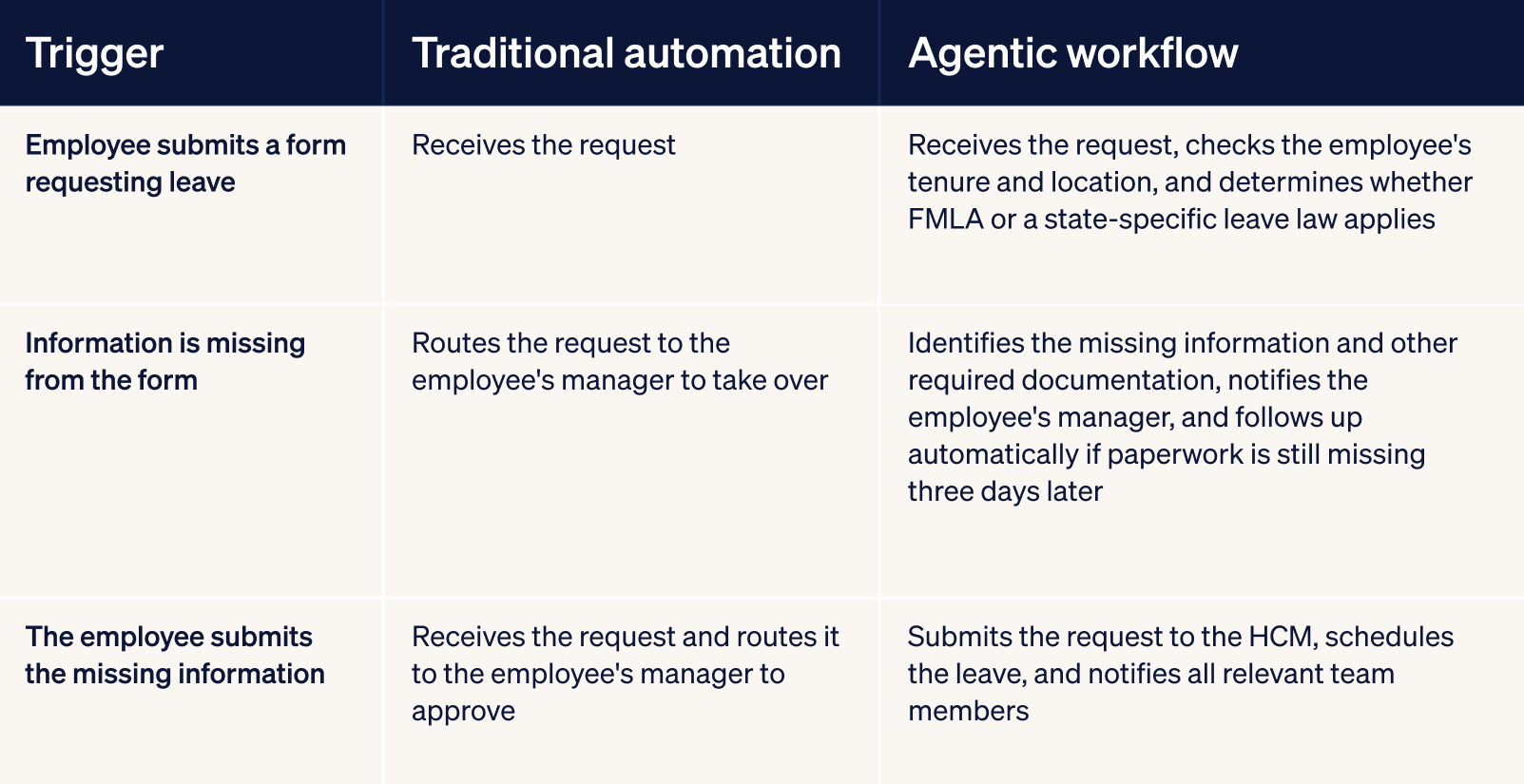
Traditional automation is powerful for predictable, repetitive tasks. If every instance of a process follows the same path, a scripted workflow can handle it reliably. The problem is that HR processes aren't always that clean. Policies vary by location. Eligibility rules change. Employees ask questions messily, in a hundred different ways. And when traditional automation encounters something outside its script, it usually just stops.
Let's look at an example in practice. Say an employee submits a leave request. Here's how traditional automation might handle it vs. an agentic workflow:
How To Build an Agentic Workflow?
Most HR teams won't build their own custom agentic workflows, but that doesn't mean you need to be an engineer to understand how agentic workflows get built. If you're an HR leader evaluating this technology for your team, knowing the process helps you ask better questions and spot vendors who are cutting corners or "agent washing" — calling technology agentic when it's actually not.
Here's the general framework:
- Define the goal and success criteria. Agentic workflows should start with a specific outcome, such as "Automate 80% of routine policy questions," or "Reduce onboarding task completion time by 50%." The more specific the goal is, the better. Vague goals produce vague results.
- Map the current process. Document every step, decision point, handoff, and exception in the existing workflow. Pay special attention to the places where humans perform repetitive reasoning (not just repetitive clicking), because that's where agentic AI can add the most value.
- Choose the right architecture. A single agent can automate straightforward, linear processes. Cross-functional workflows that touch multiple systems and teams may require a multi-agent setup. Match the complexity of the architecture to the complexity of the problem.
- Equip agents with tools and data. Connect the agent to the systems it needs, whether that's your HCM, knowledge base, benefits administration, or payroll software. An agent is only as capable as the tools and data it can access.
- Set guardrails. Define what the agent can and cannot do without human approval. Escalation triggers, compliance boundaries, and audit requirements should be baked in from the start, not added later.
- Test, evaluate, and iterate. Launch with narrow use cases. Measure accuracy, resolution time, escalation rate, and employee satisfaction. Then refine the prompts you use, tools, and routing logic based on real performance data to improve your agentic workflow over time.
The last step is where most organizations either pull ahead or stall. McKinsey's 2025 State of AI report found that top-performing companies — around 6% of those surveyed — were nearly three times as likely to fundamentally transform their workflows when implementing AI, rather than just layering AI on top of existing processes. The report shows that the difference between automating a broken process and rethinking a new process from scratch may be the difference between an AI project that delivers real value and one that gets shelved.
For HR teams, look for workflows that are high-volume, policy-bound, and span multiple systems. The best starting points tend to be employee policy questions, managing leave requests, coordinating onboarding, and supporting benefits enrollment.
What Are Examples of Agentic Workflows?
The most successful examples of agentic workflows tend to share a few traits: They target repetitive multi-step processes, operate within clear policy boundaries, span multiple systems, and have measurable outcomes. Here are some examples across different industries:
Agentic Workflows in HR
HR is uniquely positioned to act as a proving ground for agentic workflows. The function is built on high-volume, policy-driven processes that span multiple systems (payroll, benefits, HRIS, etc.) and require constant context-switching. HR requires the kind of work where autonomous agents can make an immediate, measurable difference.
As of January 2025, 61% of HR leaders were in advanced stages of implementing generative AI — a huge leap from just 19% in 2023. Even more telling was that 82% said they planned to deploy agentic AI capabilities in the coming 12 months.
Agentic workflows are already showing up in numerous areas in HR:
- HR service delivery: Agents can receive employee questions through chat, email, or ticketing systems, interpret intent, retrieve policy-specific answers based on employee attributes, and take actions like submitting requests, routing cases, or escalating sensitive issues to human HR partners.
- Onboarding: Agents can manage end-to-end new hire workflows across HRIS, IT, and other teams. They can verify documents, enroll employees in benefits, provision equipment, schedule training, and more.
- Employee relations: Agents can triage incoming concerns, assess their severity, gather context from multiple sources, and route cases to the right HR partner.
- Leave management: Agents can determine leave eligibility based on FMLA rules, state-specific leave laws, company policy, and employees' location, role, and tenure. Then, they can guide employees through the required steps, submit leave requests, and follow up on missing information or documentation.
Research by IBM suggests that when employees adopt AI self-service for routine HR tasks, enterprise companies can see 50-60% cost savings. IBM's own AskHR tool resolves more than 10 million interactions a year, saving the company 50,000 hours and over $5 million annually.
Agentic HR platforms like Wisq are purpose-built for this use case. Wisq built Harper, the world's first AI HR teammate, to learn from your company's content, knowledge, culture, and policies so she can execute tasks with speed, expertise and care, just like the highest-performing member of your HR team.
Agentic Workflows in IT
IT service management was one of the earliest and most natural fits for agentic workflows. An agent can receive a help desk ticket, diagnose the issue, run diagnostic checks, attempt a resolution, and escalate to a specialist only if their approach doesn't work.
Access provisioning is another common use case: Agents can process requests, verify permissions against role-based policies, and provision accounts across systems without IT needing to manually intervene. The pattern (high volume, clear rules, and multiple system touchpoints) mirrors what makes agentic workflows so effective for HR use cases.
Agentic Workflows in Customer Service
Customer service was another early proving ground for agentic AI, and it remains a common use case. Agents can handle incoming inquiries across channels, determine intent, resolve routine issues like checking order status and answering billing questions, and escalate complex cases with the full context attached.
Gartner predicts that by 2029, agentic AI will autonomously resolve 80% of customer service issues without human intervention, driving a 30% reduction in operational costs.
What Are the Benefits of Agentic Workflows?
The value of agentic workflows comes down to a handful of outcomes that matter to all HR leaders: speed, consistency, scale, and freeing up your team for higher-impact work.
- Operational efficiency: Agentic workflows eliminate manual handoffs between systems and reduce the time humans have to spend on repetitive reasoning tasks. That doesn't just mean doing the same work faster — it means HR departments can handle volumes of work that would require proportionate headcount growth if they were done manually.
- Consistent, policy-compliant execution: Agents (when they have good guardrails and governance in place) apply the same rules every time, in every case. For compliance-heavy functions like HR, this reduces risk and makes every decision documented and auditable.
- 24/7 availability and faster execution: Agents don't have business hours. Especially for global organizations with employees across time zones, this can fundamentally change the employee support experience. But even if your workforce isn't distributed, it means employees with questions outside work hours don't have to wait until Monday morning to get an answer.
- Personalization at scale: Agents can tailor responses based on an employee's location, role, tenure, and personal history. That level of personalization is impractical for human teams handling high-volume requests.
- Freeing up human expertise for high-value work: This is the benefit that matters most. When routine tasks are handled by agents, HR professionals can shift their focus to relationship-building, strategy, and other complex, sensitive work that actually requires a human.
The benefits are quantitative, too. IBM's HR team reported a 40% reduction in its HR operating budget over four years of AI-driven transformation, not through reduction in team size, but by redirecting capacity toward more strategic initiatives.
What Are the Challenges of Agentic Workflows?
Agentic workflows hold real promise, but they come with challenges as well: governance, integration, hallucination, change management, and more. Here are some of the most common hurdles organizations need to overcome as they implement agentic AI:
- Governance and oversight gaps: Deloitte found in 2026 that only one in five companies has a mature governance model for agentic AI. As agents continue to advance and become more autonomous, the need for clear escalation rules, audit trails, and human-in-the-loop checkpoints will only be more critical, not less.
- Integration complexity: Agentic workflows need to connect to your team's existing systems: HRIS or HCM, CRM, payroll and benefits administration platforms. In practice, integrating into legacy environments is often the most time-consuming part of implementation — and the source of the most friction.
- Data quality dependency: Agents are only as reliable as the data they work with. If your organization has outdated policies, inconsistent records, or fragments knowledge bases in the mix, it becomes significantly more difficult to train agentic AI — and the likelihood of inaccurate responses skyrockets. Good data hygiene is a prerequisite to agentic workflows, not an afterthought.
- Hallucination and accuracy risks: LLMs can (and often do) deliver plausible sounding but incorrect information; McKinsey found that 51% of organizations have experienced at least one negative consequence of AI use, with the most common one being inaccurate responses, at 30%. In HR, where wrong policy guidance carries real legal implications, accuracy guardrails are non-negotiable.
- "Agent washing:" Gartner has predicted that more than 40% of agentic AI projects will be canceled by the end of 2027 due to escalating costs, unclear value, or inadequate risk controls. In that study, Gartner also found that the vast majority of vendors who market themselves as "agentic AI" actually engage in "agent washing" — rebranding chatbots and RPA tools without adding actually autonomous capabilities. It's essential to evaluate vendors carefully when seeking out agentic tools; ask about their architecture, guardrails, and domain specificity to ensure they deliver what they promise.
- Change management: Deploying agentic AI is an organizational change, not just a technology deployment. It requires involvement from multiple departments and stakeholders and clear expectation-setting for how AI will fit into existing workflows.
None of these challenges are reasons to wait on agentic AI, but they are reasons to be strategic to ensure a successful implementation.
Frequently Asked Questions
What are agentic workflows?
Agentic workflows are AI-driven processes where autonomous agents make decisions, take actions, and coordinate multi-step tasks with minimal human intervention. They use LLMs to reason through complexity and adapt dynamically to changing conditions.
How are agentic workflows different from traditional automation?
Traditional automation follows fixed rules and typically breaks when it runs into something unexpected.
Agentic workflows can interpret context, choose the best path forward, and adjust their approach when conditions change. Traditional automation is like a script; an agentic workflow is more like a capable team member who can figure things out.
What is the difference between an AI agent and an agentic workflow?
An AI agent is the autonomous actor — the system that reasons, decides, and uses tools.
An agentic workflow is the orchestration layer around one or more agents that defines goals, sequences steps, manages state, handles errors, and determines when to escalate to a human.
What are some common use cases for agentic workflows?
The most common enterprise use cases include:
- HR service delivery: policy questions, leave management, onboarding
- IT service management: ticket triage, issue resolution
- Customer support: automated inquiry resolution
- Finance: invoice processing, compliance monitoring
How do AI agents fit into an agentic workflow?
Agents are the reasoning and action engine. A workflow might use a single agent for a straightforward process or coordinate multiple specialized agents for more complex workflows. For example, one agent can triage incoming HR requests while another retrieves policy information and a third takes action in the HCM to update payroll or benefits information.
Do agentic workflows use LLMs? How?
Yes. LLMs are the reasoning engine that makes a workflow agentic; they enable agents to interpret natural language, understand context, make decisions, and generate responses. LLMs also power key capabilities like planning, reflection, and tool selection.
What's the difference between an agentic workflow and an agentic architecture?
An agentic workflow is goal driven, meaning it starts with an end goal (like resolving an HR ticket) and then decides the best process to get there.
An agentic architecture is the broader system design, including the infrastructure, platform choices, agent frameworks, and governance model that support running agentic workflows across an organization.
What are agentic workflow patterns?
Agentic workflow patterns were popularized by AI researcher Andrew Ng. There are four of them:
- Reflection: The agent critiques and improves its own output
- Tool use: The agent interacts with external systems
- Planning: The agent breaks a goal into executable steps
- Multi-agent collaboration: Multiple specialized agents work together on a task
Are agentic workflows safe?
They can be, with the right guardrails. Safety comes from defining clear boundaries about what agents can do autonomously, implementing human-in-the-loop checkpoints for sensitive decisions, having audit trails in place, and using domain-specific training data to reduce the risk of hallucinations.
In regulated functions like HR, agents need to understand compliance issues like labor laws, privacy regulations, and company-specific policies, which are all part of safety.