Zapier CPO: 3 Keys to 80% AI Deflection on HR Tickets
Zapier's CPO reveals how to achieve 80% AI deflection on HR tickets, improve employee experience, and empower people teams to focus on high-impact work.

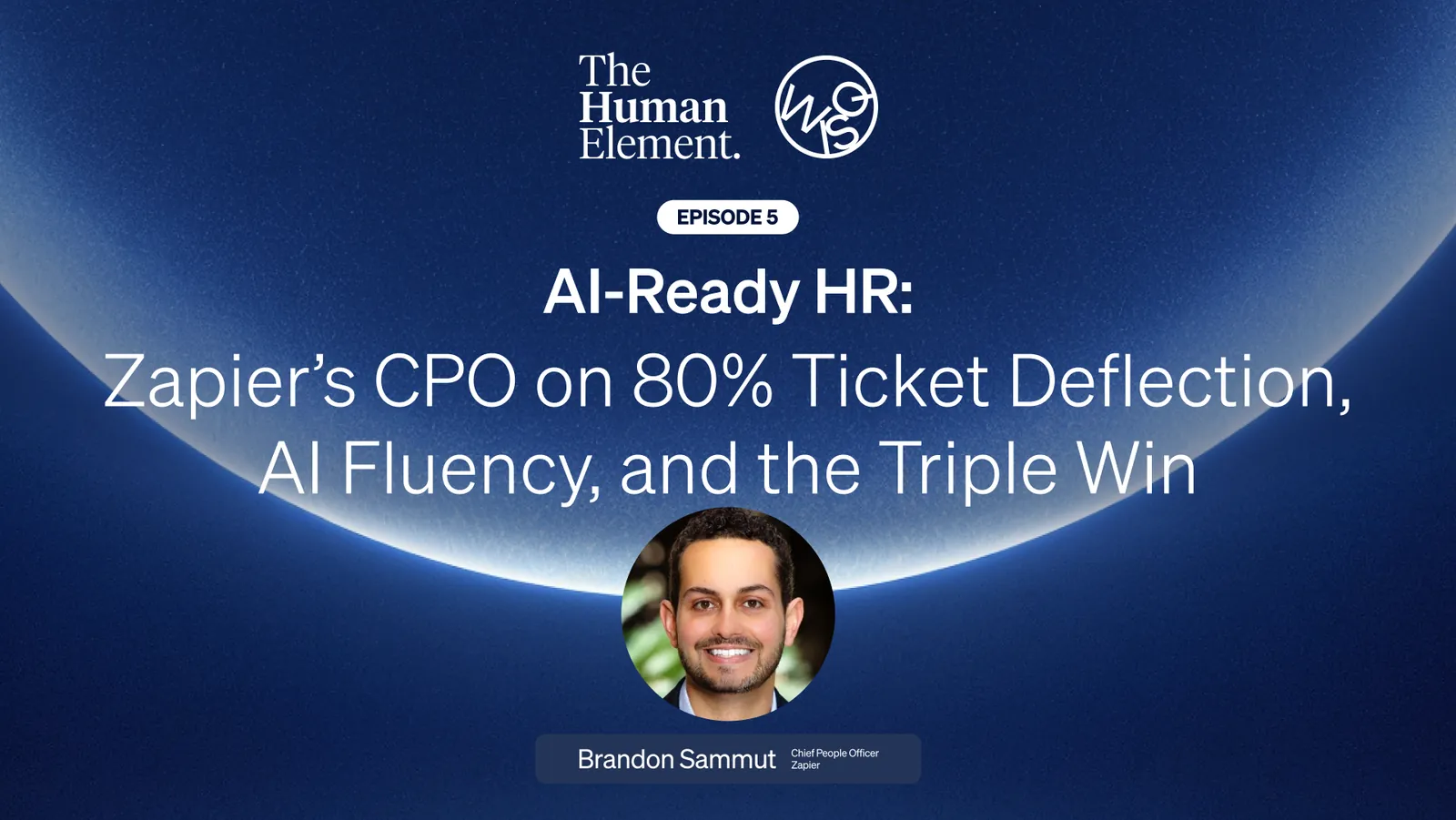
The Human Element, presented by Wisq, is a podcast hosted by Barb Bidan where CHROs and senior HR leaders share candid stories and practical perspectives on how AI and innovation are shaping the future of HR. In this episode, Barb sits down with Brandon Sammut, Chief People Officer at Zapier, to talk about practical AI adoption, the non-technical ingredients that make transformation work, and what the future holds for HR teams willing to experiment. Subscribe today.
What if your people team could eliminate 80% of routine HR questions, freeing them to focus on truly strategic, human-centered work? At Zapier, Chief People and AI Transformation Officer Brandon Sammut has made it a reality, demonstrating a practical framework for integrating conversational AI into HR operations that dramatically improves both efficiency and employee experience.
Sammut, a leader who started his career in education, views every organizational challenge through the lens of human potential and change. "The work of education is really an ongoing exercise in change," he explains, drawing parallels to how organizations must now guide their teams through AI transformation. For Sammut, AI is a tool to amplify human capability, and the opportunity is bigger than most leaders realize.
Elevating the Employee Experience Through Automation
For any people team grappling with a deluge of daily inquiries, the idea of an 80% deflection rate on HR tickets might seem utopian. Sammut's team achieved this by strategically applying AI and automation to frontline Q&A. The goal, he is quick to clarify, is not just efficiency but a better employee experience.
"One of the first places that I would suggest HR teams go when they're thinking about using more AI and automation is in frontline Q&A with employees," Sammut advises. The challenge for many HR teams is the sheer volume of questions, many of which are repetitive and straightforward, yet consume valuable human resources.
By implementing automation four years ago, and now integrating AI, Zapier's people operations generalists can automatically respond to "over 80% of the questions that come in." Crucially, this is measured by customer satisfaction scores, not just ticket closure rates. The goal is helpful, accurate, and fast responses.
Sammut describes this as a "triple win." The organization becomes more efficient in responding to HR inquiries even as it grows. Employees receive quicker, more consistent answers. And the people generalists who previously spent much of their time on routine tasks are now freed for higher-impact work. "They've abstracted some tedium out of their jobs and they're working on meaningfully higher impact work," Sammut notes. One of his people ops generalists, for example, is now completely rethinking how Zapier gathers employee sentiment, going well beyond the conventional pulse survey.
The Non-Technical Ingredients for AI Adoption
While AI provides the technical backbone for efficiency, Sammut is quick to point out that successful adoption hinges on several non-technical, cultural factors. Ignoring these can derail even the most sophisticated AI implementation.
"A company's AI opportunity starts with a health check of the organization's culture and operations," Sammut asserts. AI is a tool, and its effectiveness is directly tied to the clarity of an organization's mission, strategy, and goals. "A company that has the best AI tools... is going to have a hard time getting value out of AI if the mission is hazy or not well understood by the team."
Two cultural ingredients stand out as critical:
- Safety with Experimentation: AI adoption is an iterative process. Not every experiment will succeed, and organizations must foster an environment where trying something and failing is genuinely okay. Sammut stresses the importance of thoughtful experimentation, where learnings from failures are documented and shared, benefiting the entire organization.
- Trusted Management: "AI transformation is really a calling in to think big and differently about how we do the work we do," he explains. Strong, trusted leadership is the foundation. If employees don't trust their managers or the broader leadership, efforts to introduce new AI tools and processes will be met with skepticism and resistance. "This is ultimately a transformation that starts and stops with leadership."
The CPO-CEO Partnership: A Foundation of Mutual Interest
Effective leadership from the top is paramount for any significant organizational shift, and AI adoption is no exception. Sammut highlights the critical nature of the CPO-CEO relationship, drawing on his partnership with Zapier CEO Wade Foster.
"The number one ingredient I have found is that we have not just mutual respect for each other's people, but we have mutual interest and empathy for one another's jobs," Sammut reveals. This deep understanding means decisions are made for the greater good of Zapier and its customers, not just individual departmental interests.
Sammut shares a story about Foster demonstrating his commitment to culture. During an in-person summit, a comedian hired for entertainment began telling off-putting jokes. Without hesitation, Foster stood up and said, "This isn't what we had in mind for the evening. We're going to wrap it up here," and escorted the comedian out. "What a culture moment," Sammut reflects. "Deeds are greater than words." The kind of CEO who acts on values in real time is exactly the partner a Chief People Officer needs when leading a transformation as significant as this one.
Why Sammut Would Hire Early Career Professionals Aggressively Right Now
There is understandable concern in the broader market about whether early career professionals can find footing in an AI-driven hiring environment. Sammut sees it differently, and his reasoning is worth sitting with.
"I would hire early career folks left and center," he says. His logic is straightforward. Early career professionals are increasingly native adopters of AI, having grown up alongside the technology. They are hands-on learners by default, and AI rewards exactly that. "It's the first technology where one of the best ways to learn how to use it is to use the technology," Sammut points out. And when they get stuck, they can ask AI itself for help, collapsing learning curves that used to take years.
The concern he hears most often is that early career professionals lack judgment. Sammut partially concedes the point, but adds a caveat: AI is accelerating the development of judgment too. Simulating sales calls, practicing difficult conversations, stress-testing decisions, all of it is now available at low cost and high volume to anyone willing to put in the reps.
The competencies that matter most right now, he argues, are curiosity and the ability to pick up something new quickly. Those are not traits that belong exclusively to any career stage.
The Place to Start Is Simpler Than It Sounds
Sammut's closing advice for HR leaders beginning their AI journey: get your own hands on the keyboard.
"Our people see it when we as leaders are doing it and modeling the experimentation that we ultimately need from our whole teams," he says. Leading from the front builds the psychological safety that makes organization-wide adoption possible. And it keeps the work human-centered, which is the whole point.
To hear more conversations like this one, subscribe to The Human Element wherever you get your podcasts.