AI HR agents, explained
What you need to know AI HR agents versus HR chatbots, including what separates a real agent from a rebranded chatbot, what they can and can't do, and how to evaluate one for your HR team.

Every HR software vendor now uses the word "agent." Gartner has found that the vast majority of vendors marketing themselves as "agentic AI" are actually doing what the firm calls "agent washing," or rebranding chatbots and RPA tools without adding real autonomous capability. Gartner predicts more than 40% of agentic AI projects will be canceled by the end of 2027 for exactly this reason: unclear value, inflated claims, and tools that never did what the pitch deck promised.
So, the label tells you less than you'd think. Read on to learn what separates an AI HR agent from a chatbot.
What is an AI HR agent?
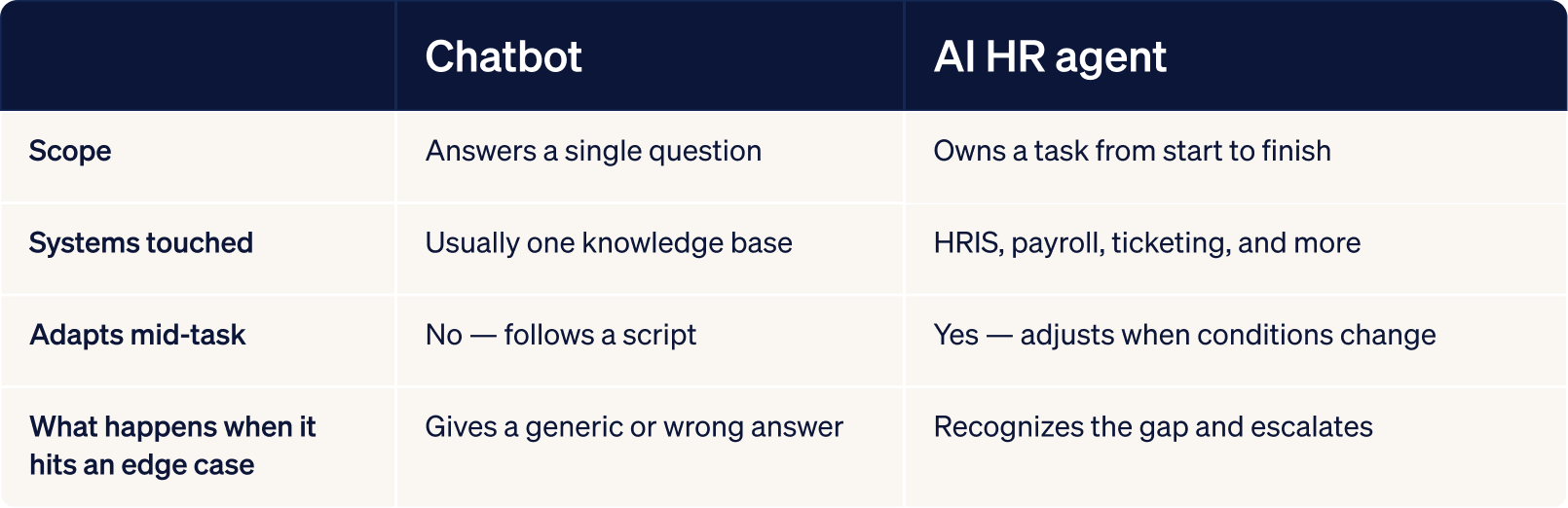
An AI HR agent is a system that takes a goal, reasons through the steps needed to complete it, and acts across connected HR systems with minimal human intervention at each step. Tell it to "onboard this new hire," and an agent can generate the paperwork, route it for signature, provision system access, schedule first-week check-ins, and update the HRIS, without a person initiating each step individually.
That's different from a chatbot, which answers one question at a time and stops. Ask a chatbot about your remaining PTO and it looks up the number and tells you. Ask an agent to handle your leave request and it checks your eligibility against your state and tenure, submits the request, notifies your manager, and follows up if documentation is missing.
What an AI HR agent can do
Most agents on the market today handle some combination of:
Employee questions with follow-through. Not just "here's the leave policy" but "your leave request is submitted, your manager has been notified, and here's what happens if it's not approved by Friday."
Multi-step processes. Onboarding, offboarding, leave of absence, and comp changes each involve several systems and several approvals. An agent carries a request through that full sequence instead of stopping at the first answer.
Personalized responses grounded in live data. An agent reading from a connected HRIS can tell two employees asking the same PTO question two different (and individually correct) answers, based on their location, tenure, and accrual history.
Escalation when it hits a wall. A well-built agent recognizes when a request is ambiguous, sensitive, or outside its authority, and hands it to a person instead of guessing.
What it shouldn't do
McKinsey has found that 51% of organizations using AI have experienced at least one negative consequence, and inaccurate output was the most commonly cited cause, reported by nearly a third of respondents. In HR, an inaccurate answer about leave eligibility or a comp exception isn't a minor error; it's a compliance problem with consequences for a real employee.
That's why the executives who talk about AI agents most confidently are also the ones most specific about where they stop it. Q Hamirani, Chief People Officer at HighLevel, put a line on it directly: "AI is never going to be able to read the room." Terminations, compensation decisions, final hiring calls, and anything touching a sensitive employee relations case stay with a person, regardless of how capable the agent is on the rest of the workload.
An agent also doesn't fix a broken process by automating it. If a leave policy is applied inconsistently across departments today, an agent will execute that inconsistency faster, not correct it. Cleaning up the underlying policy and data is a precondition, not something the agent does for you.
How to tell a real agent from a rebranded chatbot
A few questions can help you discern an agent from a chatbot:
1. Can it complete a task across more than one system, or does it only answer questions? If the demo only shows Q&A, it's a chatbot.
2. Does it need a person to approve every step, or only the steps that require judgment? If a person has to click "next" at every stage, the multi-step work isn't actually automated.
3. What happens when the request is ambiguous? Ask the vendor to show a case that doesn't fit the standard path. An agent should recognize the edge case and escalate it.
4. Where does its data come from? An agent working off live HRIS and payroll data will catch changes — a new manager, an updated policy — that a static knowledge base won't.
5. Can you see its reasoning? For anything touching pay, leave, or compliance, you need to trace why the agent did what it did. If a vendor can't show that trail, you can't audit it later.
Frequently asked questions
What's the difference between an AI HR agent and an HR chatbot? A chatbot retrieves pre-written answers to individual questions. An AI HR agent reasons through a goal, takes action across connected systems, personalizes its response to the employee asking, and escalates to a person when the situation calls for judgment.
Is agentic AI in HR the same as automation? No. Traditional automation follows fixed if-then rules and breaks on anything it wasn't scripted for. An agent evaluates context at each step and adjusts its approach, closer to how a capable employee would work through an unfamiliar case.
What HR tasks should never be handled by an AI agent? Terminations, compensation decisions, final hiring calls, and sensitive employee relations cases. These decisions change a person's life, and the people affected deserve a human behind the call.
How do I know if a vendor's "AI agent" is actually agentic? Ask whether it can complete a multi-step task across more than one system without a person approving every step, and ask what happens when a request doesn't fit the standard path. If the answer to either is vague, it's likely a chatbot with new branding.
Does an AI HR agent replace an HRIS? No. It sits on top of the HRIS and acts on the data it holds — the system of record doesn't change, but the layer that resolves employee requests does.
Where this fits into a broader HR tech stack
An AI HR agent isn't a replacement for your HRIS, payroll system, or ATS. It sits on top of those systems as the layer that acts on the data they hold. The HRIS still stores the record. The agent is what an employee or manager talks to when they need something done with that record.
Wisq's Harper is one example built for this: an HR agent trained on Wisq's proprietary HR language model, handling policy questions, onboarding, and case resolution with the employee's specific context factored in. It's one of several vendors building in this category, and the questions above apply to Harper the same way they apply to any agent under evaluation.