Cooper Standard CHRO: Stop Treating AI Like a Cure-All Pill
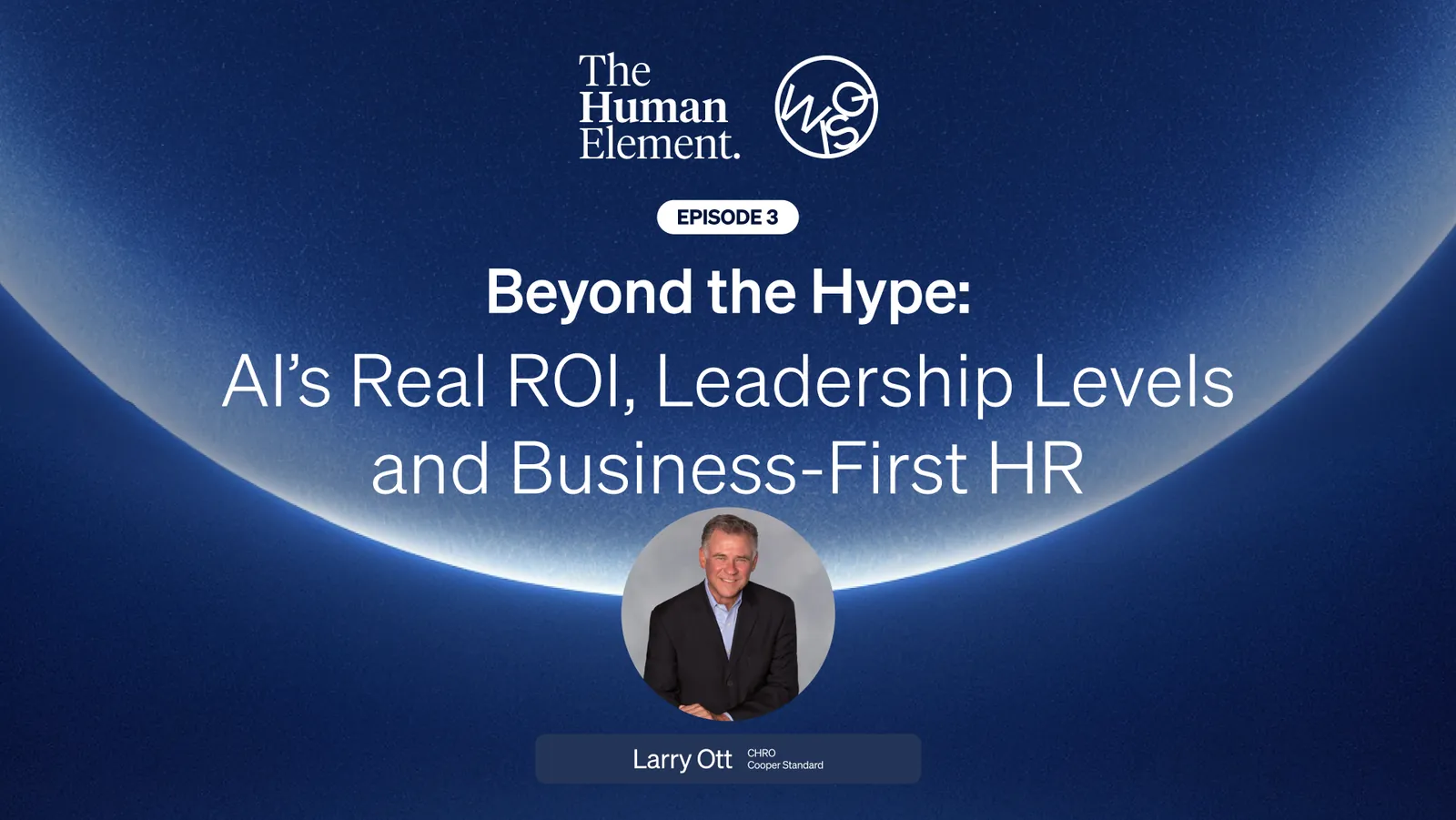
Cooper Standard Senior Vice President and Chief Human Resources Officer Larry Ott on why AI's impact depends entirely on your starting point, the case for "idle time" over headcount cuts, and why HR leaders need to put their elbows on the table.

The Human Element, presented by Wisq, is a podcast hosted by Barb Bidan where CHROs and senior HR leaders share candid stories and practical perspectives on how AI and innovation are shaping the future of HR. In this episode, Barb sits down with Larry Ott, Senior Vice President and Chief Human Resources Officer at Cooper Standard, to talk about his grounded, business-first view of AI in HR, why structure determines opportunity, and what it really means for HR to be a strategic partner. Subscribe today.
Ask Larry Ott how AI will change HR in the next 12 to 24 months and you will get an answer most people are not expecting. "I don't necessarily see it changing HR significantly in the next 12 to 24 months." He is not dismissing AI. He is doing something more useful: starting with structure.
Ott is the Senior Vice President and Chief Human Resources Officer at Cooper Standard, a global automotive manufacturer where he leads HR strategy and people operations. With more than four decades in the automotive sector, he has seen enough technology waves to know the difference between a tool and a transformation. His view on AI is shaped by that experience, and it is more practical, and more honest, than most of what gets said on the topic.
Your Starting Point Determines Your Opportunity
The reason Ott does not expect dramatic near-term change is not skepticism about AI. It is clarity about how much the opportunity varies depending on where an organization starts. "If you're structured in what I would refer to as a very traditional manner, maybe with regional business units that have their own hierarchy of HR, I think there are probably more opportunities. If you're structured using the David Ulrich model of HR business partners, centers of expertise, and business service centers, I think the opportunities are less."
For organizations that have already optimized their HR structure, AI is not going to deliver quantum leaps in efficiency. Cooper Standard's HR team of roughly 200 people is already lean, benchmarked repeatedly against industry peers. "The opportunities for us to get more lean utilizing AI aren't that great in my opinion." What AI can do is help that team do their existing work a little better and a little faster, writing job descriptions, press releases, announcements. That is real value, just not the sweeping transformation the hype suggests.
The broader point is worth sitting with. AI will amplify whatever foundation it is built on. Strong structure benefits more. Weak structure does not get fixed.
Idle Time Is the Point
Ott comes from a manufacturing background and thinks about AI the way he thinks about value stream mapping: identify waste, eliminate it, and then decide what to do with the capacity you free up. He calls that freed capacity "idle time," and he is deliberate about what it is for.
"My hope is that those five will do work more effectively, more efficiently, and then open up time to do things that we consider to be more strategic and more value added, including really focusing on how we help the business perform." The goal is not taking a team of five down to four. It is taking that same team and pointing their energy at higher-value work.
When ChatGPT became widely available, Cooper Standard saw immediate organic demand across every function. Security concerns led them to build their own internal tool. Within Ott's HR function, he assembled a think tank of 20 people who generate AI use cases on a daily basis. The rule is straightforward: if something works, spread the best practice quickly and take advantage of it.
AI Is Not a Cure-All Pill
The biggest misconception Ott sees among HR leaders is that AI will solve everything. "I think the biggest misconception is this is the new cure-all pill, like other things that came before it. Laptops, phones, computers." Every technology wave produces the same pattern: overestimation of what it will fix, underestimation of what it cannot touch.
Employee relations is his clearest example. "AI is not going to help me address employee relations issues. I have a very talented team and quite honestly I don't think any of them would consult AI to say how do you have a tough conversation with a leader who's not leading." Some of the most important work in HR requires human judgment, trust, and relationship. No tool changes that.
He draws an analogy that lands well. When handheld calculators arrived, they changed how work got done. They did not change what work was worth doing. AI is similar. "I equate it to back in the day, when handheld calculators arrived. It changed how we do work. AI can change how we do work." The capability shift is real. The fundamentals of good HR leadership are not going anywhere.
Leaders of Others, Not Just Leaders of People
One of the most distinctive things Ott is doing at Cooper Standard has nothing to do with AI. He is changing the language around leadership roles, moving from vague titles to a more precise framework: leaders of others, leaders of leaders, functional leaders, product line leaders, business unit leaders, and enterprise leaders. The distinction matters because each level requires different capabilities and a different understanding of what the job actually is.
"We tend to promote the best doer into a leadership role, and then they often don't understand that leading is the key part of their job, not just a sideline." Cooper Standard is addressing this with mandatory immersion programs for new leaders rather than optional courses. The old approach was putting information out and hoping the horse drinks the water. The new approach is getting in the water with the horse.
The reason this matters for AI adoption is the same reason it matters for any transformation: leaders are the change mechanism. If they do not understand their role, no technology initiative will take hold.
The Real AI Opportunity Is in the Big Rocks
For Ott, the significant AI opportunities at Cooper Standard are not in shaving time off HR processes. They are in manufacturing, product development, and purchasing, places where AI can drive what he calls "quantum leaps of improvement that bring dollars to the bottom line."
"It's going to be working with manufacturing and purchasing to reduce our material costs as a part of revenue. That's where the goal is." This framing repositions HR's relationship with AI from defensive, focused on protecting jobs and managing change, to offensive, focused on finding the biggest business problems and applying the right tools to them.
It also reflects a philosophy Ott has held for his entire career. "I bristle every time somebody uses the term support department. I would much rather focus on the business strategy and let the HR initiatives fall out of that business strategy than spending all my time doing HR for HR."
Elbows on the Table
His closing advice for HR leaders navigating transformation is the most direct thing he says in the episode. When you walk into a leadership meeting, a budget review, a performance discussion, leave the HR hat at the door. Think about inventory levels, material costs, business performance. Ask the questions nobody else will ask. "Sometimes the questions an HR person might ask are questions that nobody else wants to ask and they're questions that should be asked."
His phrase for it is simple: elbows on the table. Be part of the discussion. Help drive the business forward. AI is one tool in that effort. Business partnership is the whole job.
To hear more conversations like this one, subscribe to The Human Element wherever you get your podcasts.