Toshiba CHRO: 3 Questions Before Any HR AI Investment
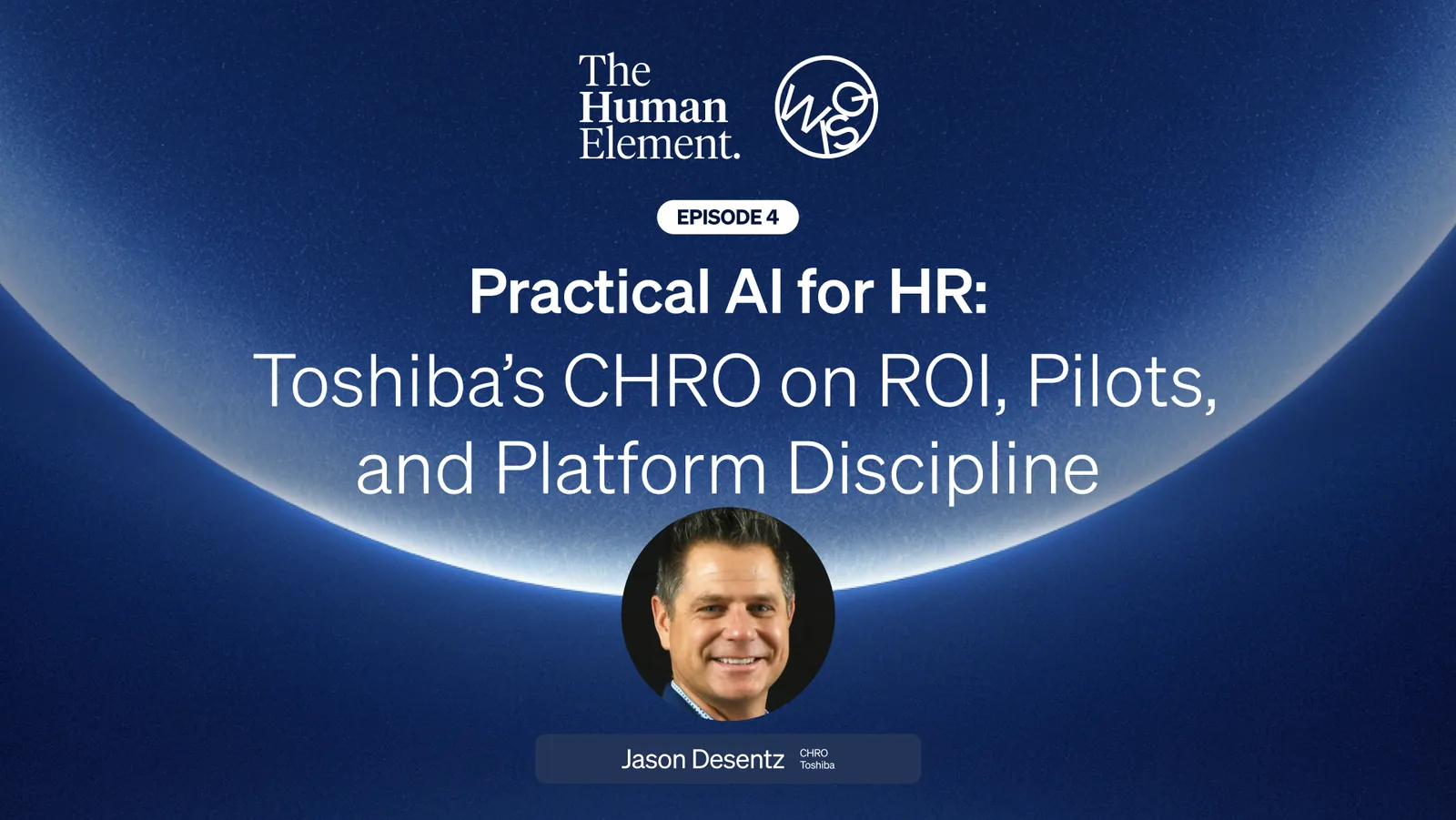
Toshiba Americas Chief Human Resources Officer Jason Desentz on building an ROI-first case for AI, avoiding the bolt-on trap, and why the best HR leaders right now are iterators, not innovators.

The Human Element, presented by Wisq, is a podcast hosted by Barb Bidan where CHROs and senior HR leaders share candid stories and practical perspectives on how AI and innovation are shaping the future of HR. In this episode, Barb sits down with Jason Desentz, Chief Human Resources Officer at Toshiba Americas, to talk about his practical, results-first approach to AI adoption, how to build organizational AI literacy, and why asking more questions is the most underrated leadership skill right now. Subscribe today.
The conversation around AI in HR often swerves into abstract futures or fear-mongering. For too many leaders, the sheer volume of speculative discussion has become a source of paralysis. Jason Desentz, Chief Human Resources Officer at Toshiba Americas, cuts through the noise with a straightforwardly pragmatic stance. His approach is not about chasing every new tool. It is about anchoring every decision to core business value and the human experience.
"The challenge with a lot of HR professionals in the AI space is really thinking about it from a business perspective sometimes rather than what their really end result is," Desentz says. "For me, it's about how do I build the ROI case? Because with AI, it's not cheap."
Before making any significant AI investment, Desentz works through three questions. Does it demonstrate clear ROI? Will it cause minimum to no disruption to the business? Does it improve the employee experience? These are not theoretical filters. They are the practical guideposts he applies to every implementation decision, AI or otherwise.
Stop the Bloat: Why HR Needs AI with a Purpose
The last decade in HR technology was defined by consolidation. The push for a single HCM system aimed to end the sprawl of disparate tools. Now, AI risks undoing that progress with a new wave of bolt-on bots. Desentz is direct about the danger: "We're going to go right back to where we were before, managing at least an average of eight different systems. And that's going to cause a lot more challenges and a lot more cost."
His antidote is strategic entry. Recruitment is where he recommends starting. "If I start with recruitment, I find that it's probably an easier ROI case for me to sell. I can show its value quicker." Starting there minimizes disruption because it augments existing processes rather than overhauling core systems, and the business case is straightforward: faster, more efficient hiring with a clear impact on outcomes.
The broader principle is an impact-effort matrix. Start with the low-hanging fruit, the simple, painful tasks that AI can streamline immediately. "I think every HR person would never want to fill out an I-9 manually ever again." Prove value there, build momentum, then move to the higher-effort, higher-impact problems.
Getting People AI Ready
Beyond evaluating technology, Desentz focuses heavily on preparing people to use it. At Toshiba, that means building what he calls an AI-ready workforce through Toshiba University, a structured learning program built on a new LMS system. "The adoption of understanding AI first before any organization starts to use it is really important."
The generational dimension is worth acknowledging honestly. Desentz, a self-described Gen Xer, is candid about where his peers start. "If you're a Gen Xer like me, you're thinking of Skynet and Terminator. You're thinking it's going to take over the world." Gen Z, by contrast, has been using AI tools for years and barely registers the shift. Building AI literacy means meeting people where they are, starting with the basics for those who need them, and not assuming a shared baseline that does not exist.
Rather than mandating top-down training, Desentz leans on organic momentum. Champions are already surfacing at Toshiba, people who have been experimenting on their own and building fluency ahead of any formal program. "A lot of our folks are just naturally bubbling up through the organization and we're kind of latching onto them." Those people become the trainers, mentors, and department-level guides who make adoption real rather than just assigned.
Proof of Concept: Iterator, Not Innovator
Desentz pushes back on the pressure HR leaders feel to innovate with AI. His framing is more useful: be an iterator. "Henry Ford didn't invent the car. What he invented was a better way to build the car for a cheaper price." The lesson for HR is to focus on improving existing high-impact processes rather than chasing unproven, radical change.
Pilots should be built for 80% of the population and then address the remaining 20%, not the other way around. Trying to design for every edge case before launch leads to paralysis. Trust has to come first. "I have to have the trust first before I can really introduce anything." That trust gets built by clearly articulating the why, the benefits, and the realistic implementation impact before asking anyone to change how they work.
The Power of Planned Abandonment
One of Desentz's sharpest concepts is what he calls planned abandonment, borrowed from Peter Drucker. Organizations get attached to programs that are no longer delivering. Nobody wants to say "my bad." But if a solution is not meeting the two core guideposts of minimum disruption and improved employee experience, the right move is to acknowledge it and change course.
He puts his own spin on the old Ron Popeil "set it and forget it" line: set it, forget it, reflect. Continuous improvement requires looking back, not just forward. "How's that working for us? Did we get the value we were thinking? Is it actually improving people's lives?" The willingness to honestly answer those questions, and act on the answers, is what separates HR leaders who get lasting value from AI from those who end up with expensive shelfware.
Listen, Learn, Lead
Desentz's closing advice for HR leaders starting their AI journey is built around three words: listen, learn, and lead. Listen to the fundamentals of whatever platform or service you are evaluating. Learn from adoption rates, customer experiences, and peers who have gone first. Then lead by asking more questions, not fewer.
He closes with a line that lands: "How come we start off life as a question mark and end as a period? We need to go back to being the question mark." For a technology space moving as fast as AI, curiosity is not just a nice quality in a leader. It is the operating posture that keeps organizations from getting left behind.
To hear more conversations like this one, subscribe to The Human Element wherever you get your podcasts.